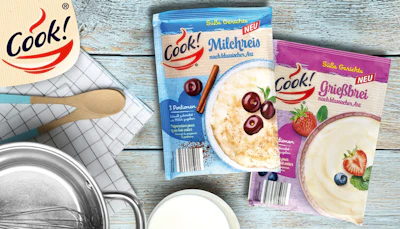
The recent paperization trend is not just a U.S. phenomenon. European brand owners, like their American counterparts, are also moving away from plastic in favor of paper to align with recycling regulations and evolving consumer expectations. In Fürth, Germany, discount grocery store chain NORMA recently embraced “fiberization”—as it’s referred to there—adopting a recyclable barrier-paper pouch for its private-label line of dry cream of wheat and rice pudding products.
Produced and supplied by German grain-based food manufacturer Friessinger Mühle, the products were previously packaged in a paper composite, comprising paper, plastic, and aluminum. Explains Alexander Gurr, packaging purchaser for Friessinger Mühle GmbH, the change to the new pouch material was done in collaboration with Koehler Paper at the request of NORMA for “sustainable, monomaterial packaging.”
Says NORMA’s head of central advertising and communications, Katja Heck, “Here at NORMA, we’ve set concrete goals when it comes to packaging. First of all, we want to reduce unnecessary packaging material. To do that, we’re taking a very close look at the packaging we’re using for our private label and analyzing which packaging materials are needed and which aren’t. Secondly, we want to check all our packaging to see whether we can replace it and use environmentally friendly materials instead. Our goal here is to make sure that we conserve resources along our entire value chain—all the way from production to sales.”
The new material was selected for its recyclability as well as its ability to deliver the same performance as the existing material. Explains Gurr, products such as cream of wheat and rice pudding require packaging that provides barriers against grease, mineral oil-saturated hydrocarbons (MOSH), and mineral oil aromatic hydrocarbons (MOAH). “Naturally, the paper must be easy to print on and also easy to seal in the packaging machines,” he adds. “The processability in the packaging machine is also very important.
“This requires getting to grips with the new material, gaining experience, and possibly making changes to the machine.”
To meet these specifications, Friessinger selected Koehler NexPlus Advanced barrier paper. NexPlus Advanced eliminates plastic in favor of a water-based dispersion coating on the inside of the pouch to provide barrier. “This established process in paper manufacturing gives us considerable leverage to reduce plastic consumption,” explains Alexander Stöckle, corporate director of marketing and communications and press spokesperson for Koehler Group. “The dispersions we use are compatible with recycling systems, and the paper’s recyclability has been verified in conformity with the Cepi standard [the Confederation of European Paper Industries recyclability test method and evaluation framework for paper and board standard].”
Stöckle adds that an in-house lifecycle analysis of NexPlus Advanced for chocolate bars indicated that the material offers a 50% smaller carbon footprint than biaxially oriented polypropylene for the same product. “We have additionally calculated the carbon footprint for all our barrier paper,” he says.
Friessinger is using NexPlus Advanced to create a three side-sealed pouch for the cream of wheat and rice pudding products for NORMA. The material is gravure-printed in six colors by European-based converters. According to Gurr, “In the end, the adjustments [to the packaging machinery] were minor, and the process of switching was closely supported by Koehler Paper.”
NORMA’s discount grocery stores are located in Germany, France, the Czech Republic, and Austria. PW