Packaging World:
You indicate on your website that you pioneered recycling and composting of single-use cups at sports and entertainment venues, but found those solutions didn’t work. Why is that?
Michael Martin:
 Michael Martin, founder and CEO, r.Worldr.World
I spent 25 years trying to get people to recycle at live events. I’m the one who introduced recycling at live events back in 1990. There was never recycling before. Later I introduced composting. That had never been done before either. We attempted a variety of different strategies, including signage, gamification, and trash goalies [volunteers or staff members who monitor recycling and compost stations to prevent waste contamination]. Live Nation hired me to develop their sustainability strategy, and they gave me free rein. I eliminated all the plastic, replaced it with bioplastics and recycling, and we just had compost and recycle bins, no trash bins. It was a perfect solution.
After every live event, the cleanup crews leaf-blow or shovel everything on the ground, which is 80% of the waste, and throw it into a dumpster. And inevitably people [people attending the event] are drunk, and they throw things in the wrong bins. And so everything is co-mingled. So it’s a dirty little secret of the live event industry that, while they have recycling bins and compost bins, 90% it goes to landfill.
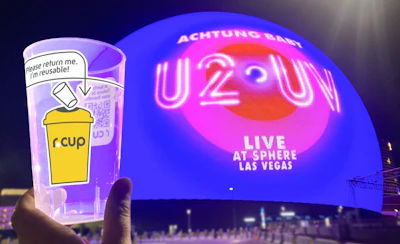
So I got really depressed for about six months. I spent 25 years at this point trying to make recycling and composting work. And then I remembered what I’d seen with U2 in Europe where they were doing a reusable cup system. That’s when I thought, “We got it. We think about reduce, reuse, recycle. That’s an order of priority, and we need to get people thinking about moving to reuse from recycle.”
How did you develop a reusable system?
If you’ve looked at my background, I’ve worked on catalyzing or promoting or growing some key sustainability movements over the years, including Earth Day, climate change, hybrid cars, green energy, organic and plant-based food, and corporate CO2 reductions. I thought, “Well, let’s see if we can launch the reuse movement.”
Because I had these relationships with all these leading artists, I realized that was the way to introduce it to this country. So that’s how we started off—with artist-branded cups. We had a $3 deposit, and you could return the cups at the end of the event and get your money back or you could keep the cup. It was so exciting because for the first time ever, there was no waste because people didn’t throw their trash on the ground. And I thought it was the most brilliant solution ever. Then I started analyzing it and realized, wait a minute, we’re just creating more waste by selling souvenir cups, which are not good for the environment. That’s why we morphed to this model where we have these “ugly” cups that people don’t want to take home.
They still do a bit, but not very much. We say to people when they’re leaving a venue, do you take the cups from the restaurant you eat at? It’s like this mind tear for people because they don’t think about it that way. It’s about re-educating people. I’ll say, this cup’s going to be used here again tomorrow, so please leave it here. It’s a complete re-education, and we’re using this platform of influencer to do this effectively. We’ve also added a QR to the cup. If people scan the code, there’s all this information about the reuse crisis, and they can learn all about it.
 According to Martin, r.World switched to "ugly" cups to ensure venue-goers would be more likely to return them, rather than bringing them home.r.World
This mindset shift—would you take home your cup from a restaurant—is a powerful way to think about reuse.
We also use really high-quality cups, so they’re clearly not throwaway. People then look for our bins. We feel like we’ve cracked the code on the waste crisis at live events because over half of the audience will put the cups in the correct bins, which does not happen with single use.
We’re also finding that it saves money on cleanup crews, because there’s less waste left on the ground. The venues are also throwing out and recycling less waste. So there are some real economic benefits to reuse.
How have you approached challenges such as the initial investment, the logistics required to collect the cups, cleaning and sanitizing the cups, data analysis, and consumer education?
When I started the company, I thought it’d be really easy to just wash some cups. No problem. Wash them, bring them back. But it’s unbelievably complicated and complex. We’ve designed the system so that, for our clients, it’s as simple as using single-use cups, and they get all the economic and environmental benefits. Behind the scenes, we’ve been very fortunate. We have a board comprised of successful business leaders, and we’ve structured what I think is the most professional operation in the country—maybe in the world, I’m not sure—but we’ve figured out how to do it right. We were able to raise the funds to get the right people and right systems in place.
I’m a former investment banker, so I’m all about analytics and quantification. We have a full-time person where the majority of his work is just analyzing all the data and creating impact reports and in-depth analysis of the environmental methodology. Before I started the company, we did a lifecycle analysis to determine the optimal type of materials and how to structure everything. A big part of this is the education aspect, and with my background, so much of what I’ve done over the years has been educating the public on these different issues. So we do A/B testing to determine the best messaging for the optimal impact.
From a client standpoint, there’s no upfront investment needed. If they want to provide their own cups and serveware, they can do that, and we can just wash for them. But for the most part we provide a complete turnkey solution. [Clients pay a fee per cup, similar to a linen service, reimbursing r.World if cups are not returned.]
We’ve designed the most advanced turnkey system in the reuse industry. It’s called r.Turn. It’s our tech platform, and it allows us to handle all aspects of reuse, including inventory, ordering, freight tracking, impact reporting, invoicing, and so forth.
How do you gather data on inventory and turns?
We track cups and serveware in bulk, so we have QR tracking on all our totes. When we deliver the cups and serveware, we scan all the totes, and that feeds r.Turn. Then when we collect the items, we count them all as we’re sorting the waste. We then work with our clients to get monthly inventory reports to come up with harvest reports for our clients.
What information is in the reports you provide your clients, and how do they use this information?
They get a report that gives them the number of cups, pounds of waste eliminated, gallons of water saved, pounds of CO2 eliminated, liters of crude oil saved, and kilowatt hours of energy saved. A lot of clients will just post the report itself, and they will aggregate the information and use it for their environmental impact reports. It’s exciting, because as you know, what you don’t measure, you can’t change. This allows them to see and quantify the impact and the benefits. And that’s how we know that we’ve just passed the 22 million-count of cups washed because we’re doing a million a month
What do you see as the future of reusable packaging as a mainstream sustainability strategy?
There are several issues. The first is that the country’s been trained that recycling works, and there’s this feeling that you can put stuff in the container, and it’s all good. But there’s no such thing as away. You’re not throwing it away, you’re not recycling it away, you’re making it somebody else’s problem.
There’s a need for recycling, there’s a use for composting, and sometimes there’s even a need for single-use aluminum cups—maybe. But optimally, you have to get away from single use overall. So the first problem is that people are brainwashed into thinking recycling works. You have to get people to start thinking about reuse. One of the things I’ve advised my clients is if you want to do reuse, do it in Denver. We’ve been there for coming up on four years. The whole state has sampled reuse, and they would understand it in an open-loop environment.
The second problem is how do you do collection in a way that makes environmental and economic and operational sense, even if a whole community wants to return things, right? What Ridwell Recycling [a subscription based service for doorstep pickup of hard-to-recycle items] is doing is really cool. If there was a way to expand Ridwell to collect that type of stuff, that’s a good solution. Or if waste haulers had an extra bin to collect the reusable packaging. Otherwise it’s going to be a matter of putting it in a UPS box and shipping it back or trying to take it back to a grocery store. It’s hard enough to remember to bring in a reusable bag, so it’s going to take a generation of re-education.
If reuse is legislated, if big CPGs have to [create reusable packaging], that’s probably going to be the portal through which reuse will happen at scale. I do think CPG reuse will be coming though eventually though.
I must admit, I get a little frustrated sometimes. I bought a hand-soap product in an aluminum bottle that I use to fill a reusable glass bottle with a pump dispenser. But I wonder, why can’t I just use the aluminum bottle with a pump on it instead of having an extra glass container? It just doesn’t make sense sometimes. Is it really making a difference?
It’s hard, and it goes back to what you want to solve for. One of the things we learned early on is that it takes three ounces of water for us to wash a cup. I thought, “Oh my God, this is horrible, I should just hang it up.” Then we found out that it takes 66 ounces of water to make a new single-use cup. So actually we’re about 20-times better. And we find that that applies to pretty much all the environmental characteristics, which is why we have this great environmental impact reporting we can do. With your example, it’s true, what are you solving for? There are so many different factors.
In a lot of ways, given what’s going on in the world, the number one focus needs to be on CO2 emissions. Having created the first climate change campaign, it’s been sad for me to see how we’re going backward on COP [the UN Framework Convention on Climate Change] right now.
So should we be focusing on reducing CO2 emissions, rather than having a goal of recyclable or compostable containers, or recycled content?
Again, it depends on what you’re trying to solve for. I have a company that’s focused on reducing plastic waste. We’ve stopped about 120 tons of plastic from being produced. I’m really proud of that—reducing plastic production reduces CO2 emissions. But on a macro level, climate change is what’s going to kill humanity if we don’t get it under control. Or it may not kill us, but it’s going to drastically change the world as we know it.
One of the things we show clients when we talk about what do you want to solve for is a slide that aggregates all the different options. So for aluminum, it’s not plastic, but there’s all the magnesium in the cup and the slave labor for the production of the magnesium and the toxins in the water. In addition, 80 to 90% of these cups at live events go to landfill due to commingling. While aluminum cups aren’t plastic, what these cup manufacturers forget to say that it has a plastic liner that comes off in the dishwasher. Then there are compostable cups, where there are challenges with the chemicals and pesticides and energy it takes to make it and then ship it and then use it. And then I’m sure if these cups get commingled with recycling, they contaminate recycling loads.
 Included in r.World’s turnkey service are the serveware and collection bins (pictured), on-site staff training and support, marketing materials, free deliveries and pickups, monthly environmental reports, the r.Turn app, and sanitization and quality control.r.World
Clients freak out when they see that these are worse environmental options than a single-use plastic cup. It’s just about getting people to think about the damage of single-use anything.
I’m trying to get USGBC [U.S. Green Building Council] to redefine what true zero waste is. I said, “You guys are awarding venues, saying they’re true zero waste, when in fact what they’re doing is they have recycling and composting set up and they send off contaminated loads of recycling and compost that many times just go to landfill.” I would say that recycling and composting are both waste, and true zero waste is you’re not generating waste. Because if you think about what has to happen once those materials leave a building, there’s a lot of environmental impact, even if it does get recycled or composted. And of course that sort of blows their mind like, no, we view recycling as not being waste.
So what drives you in your pursuit of a more sustainable world? What compelled you to move in this direction in your life?
I had just finished my MBA from Kellogg and I was on my path to becoming a very successful investment banker when Exxon Valdez happened. I had this full-stop realization of, wait a minute, there’s something that’s not right about the capitalistic system that requires quarterly growth over a natural environment that has finite resourcs. And then I started to really learn some of these things about the environment in terms of what’s happening with our bodies—there’s plastic in it—and what’s happening in the rainforest and other parts of the environment, impacting our health, climate change, toxins, rainforest, species extinction, etc. Once you really learn about it, if you have any sort of empathy or heart, you can’t not do something about it, right? It’s like you just can’t put it away and close the door. I see this, and it feels like this needs to be addressed. The problem with so much of this is that you’re going up against existing infrastructure and existing norms.
There are six or seven perceived obstacles to converting to reuse. One is misinformation. People think it’s too complicated, they think it won’t work. They think that aluminum cups are better for the environment, when they are the worst option. And so that sometimes is a full stop. Then you’ve got apathy, you’ve got inertia, existing infrastructure, you’ve got convenience. It’s a lot easier to throw something out. And then there are the economics. It can sometimes cost more to do the right thing for the environment. We have found reuse can actually be a revenue generator. Obstacles to change applies to a lot of different issues and is probably the reason we’re in the challenge we’re in across the board, from the fossil fuel industry to the CPG world to the waste world.
I feel more optimistic than I have in a while with EPR and with some of the recent technology around sustainable packaging. What’s your outlook?
Yeah, I mean there’s a huge delta between aspiration and action, and that delta is where there is friction and when stuff falls off. Most people in big corporations aren’t fired for keeping the status quo, but they could be fired for doing something different. And that leads to, why take a risk on changing? But I do agree with you. I lecture at universities a lot, and when I was in school, there wasn’t a sustainability class on the docket. Now there’s a whole generation that’s ramped up and dialed in and knows what needs to be done. That does give me optimism—provided the nihilism they’re experiencing doesn’t overtake them. It’s hard to be young these days. PW