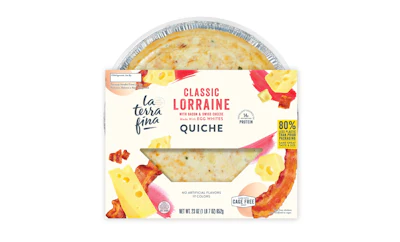
Union City, Calif.-based homemade-style dip, spread, and quiche company La Terra Fina has redesigned its quiche packaging to remove several components while preserving product protection and shelf appeal. The update rolled out first to club stores last August, followed by retail channels in November, and targeted plastic packaging materials that consumer feedback indicated was excessive.
“At La Terra Fina, developing more sustainable packaging is a natural extension of our commitment to environmental stewardship and continuous improvement,” says Rose Hartley, sustainability manager for La Terra Fina. “We view sustainability as an opportunity to simplify the consumer experience, removing complexity and non-value-added components.”
The existing packaging format included a clear plastic dome, a black plastic tray, an aluminum baking tray, an easy-peel protective film, and a printed paperboard sleeve. The updated system eliminates the dome and tray entirely. What remains is a recyclable aluminum tray paired with a protective film seal and an upgraded, recyclable paperboard sleeve.
 For Costco and Sam’s Club variety two-packs, the new format cuts plastic use by 75%.La Terra Fina
“Eliminating those components allowed us to achieve dramatic material reductions while still maintaining product protection and shelf appeal,” says Tom Chole, VP of innovation and operations. “Out of all the product innovations I have been involved with, this one has the biggest impact to the environment.”
For Costco and Sam’s Club variety two-packs, the new format cuts plastic use by 75%. Retail quiches sold through Kroger, Safeway, Sprouts, and Albertsons now use 80% less plastic. The change also trims paperboard use by 18% per two-pack and corrugated cases by 28%, enabling denser palletization and fewer truckloads.
While the redesign focused on material reduction, La Terra Fina also maintained sustainability features from the prior package, including FSC- and SFI-certified paperboard and sustainable inks. It also retained the clear film window so shoppers can still see the product, an attribute that Hartley says is essential to shelf appeal. “Less packaging, thoughtfully designed, delivers a better customer experience while reducing waste and cost,” she says.
Notes Chole, the transition required some refinement of the remaining packaging components. Early tests showed that the fit of the paperboard sleeve could cause minor abrasion to the easy-peel film, prompting adjustments to both the sleeve geometry and the die-cut folded paperboard design to improve durability during handling and distribution. Chole adds that retail partners, including Costco and Kroger, were “open, collaborative, and highly supportive” throughout the process.
According to Hartley, retailers and consumers have responded positively to the change. Wrote one shopper, “Thank you for reducing the plastic packaging. We love the product but had stopped purchasing it due to the plastic waste. Happy to add it back in our rotation.” PW