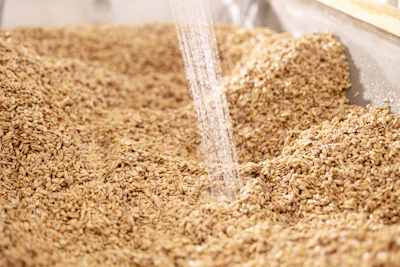
Moisture control is crucial, and byproducts must meet a defined moisture target before they can be upcycled to ensure consistent finished product moisture.
Parilov/Adobe Stock
“Upcycled” ingredients are currently one of the biggest challenges faced by the food industry. With nearly one third of food processing ingredients ultimately heading to waste, there is a dire need to find ways to use ingredients that would otherwise go to landfill. As the industry navigates more sustainable ways to manufacture food, this is an area being explored more actively in today’s product development landscape.
What are upcycled ingredients? These are typically considered byproducts that are discarded after food processing. Examples include peels, stems, apple pomace, fruit pulp, and vegetable scraps. Various technologies are available to further process these materials, break them down, purify them, and extract valuable components, such as dietary fiber and bioactive compounds from these discards.
Some of the technologies used in today’s food manufacturing environment include mechanical separation, enzymatic hydrolysis, and hydrothermal processing to extract fiber from food-processing byproducts.
Ironically, upcycled ingredients do not necessarily mean cheaper or lower cost. Collecting byproducts, extracting usable ingredients, purifying, and repacking them all come with added costs. However, these methods are more sustainable and support a circular economy where resource efficiency is improved by reducing waste, increasing value, and lowering the carbon footprint.
Niveditha Ravishankar is an R&D Manager at McCain Foods with over a decade of experience in product development including confectionery and frozen foods. Her expertise spans ingredient technology, clean-label formulations and processing innovation.McCain FoodsThe challenges do not end there. Pilot to scale-up challenges are common when using upcycled ingredients. Waste streams are often not consistent ingredient sources due to variability in color, moisture, and nutrient availability from batch to batch. This is no different from using agricultural products as ingredients. However, the food industry has historically been able to streamline manufacturing processes for those inputs. The challenge now is producing consistent ingredient quality from upcycled sources.
At pilot scale, this variability is relatively manageable in small batches by controlling moisture, texture, and flavor with additives. These controls become far more difficult to navigate in large-scale production. However, there are proven strategies that can help in these scenarios.
Moisture control is crucial, and byproducts must meet a defined moisture target before they can be upcycled to ensure consistent finished product moisture. This can eliminate batch to batch variation in large-scale production without requiring frequent process adjustments.
Particle size is another key contributor to texture and mouthfeel, as well as water absorption. Controlling particle size prior to blending into large batches supports more efficient processing.
Blending multiple batches also helps reduce variability by combining large volumes from multiple sources. Blending multiple batches after moisture, particle size, and stability have been standardized helps average out variability and supports consistent large-scale production.
It is also essential to stabilize microbial and enzymatic activity using methods such as pH adjustment and thermal blanching. Agricultural ingredients inherently come with variability. Therefore, it is important to define reasonable operating ranges rather than fixed targets to avoid unnecessary product waste due to overly tight specifications.
Implementing a tiering system, such as Grade A and Grade B ingredients, can further improve processing efficiency by aligning ingredient quality with the requirements of the final product. Overall, having a clearly defined gold standard product and maintaining a tight feedback loop between quality assurance and operations, allowing process settings to be adjusted and issues addressed in real time rather than post-run, is essential to reducing losses.
As infrastructure, technology, and industry collaboration continue to mature, these challenges are increasingly solvable. Companies that approach upcycled ingredients with the same operational rigor applied to conventional raw materials, while adapting processes to their unique characteristics, will be best positioned to scale sustainably.
Ultimately, integrating upcycled ingredients into mainstream manufacturing is not just a sustainability initiative, but a manufacturing evolution that aligns environmental responsibility with commercial viability.
 Niveditha Ravishankar is an R&D Manager at McCain Foods with over a decade of experience in product development including confectionery and frozen foods. Her expertise spans ingredient technology, clean-label formulations and processing innovation.McCain Foods