The newly released 2025–2030 Dietary Guidelines break with recent advice, revive older principles, and raise scientific questions—reshaping food labeling, formulation, and product innovation across the industry.
U.S. Department of Agriculture/U.S. Department of Health and Human Services
Eric F. GreenbergIn our last column, we described the Dietary Guidelines for Americans, which have enormous influence on food labeling claims and package configurations each time a new edition appears. At the time, the new 2025-2030 DGA were expected at any moment, and we predicted what they’d look like. In early January, they finally appeared, so here’s the analysis of them as they actually look.
In short, the new DGA reinforces some diet advice that we’ve seen before, seems to resurrect advice from over 40 years ago, and contains a few bits of advice that at present don’t appear to be based on established science, though they might turn out to be right based on future research.
Once again, for expert insight, I will call upon Dr. Robert Post, a food and nutrition regulatory and policy affairs consultant, who previously held important positions in the federal government and led development of past editions of the DGA and related symbols.
First as to form: As promised by those preparing it, the new DGA document is much shorter than more recent editions. It’s 9 pages long, and while the past several editions had been over 50 pages in length, even earlier editions were also in short, brochure-type formatting. The new one, like past editions, is accompanied by lengthier supporting documents. Post says the regulators behind the DGA—Health and Human Services, which includes the Food and Drug Administration, and the U.S. Department of Agriculture—“deserve credit for highlighting dietary public health issues.” He commends the shorter format, saying “a 9-page document has the advantage of capturing consumers’ attention and making it easier to understand and adopt the recommendations.”
In terms of substance: As before, the new DGA emphasizes the importance of eating vegetables and fruits, and fiber-rich whole grains, and limiting added sugar. And now, they have added that snack foods should meet FDA’s recently revised definition of foods that are “healthy.”
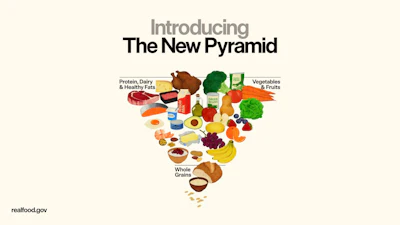
The graphic representation of the new dietary advice is a retro version from the past; an upside-down pyramid, and some of the new DGA’s advice does indeed turn past advice on its head. As Post says, “there are some stranger things in the upside-down.”
Probably the most notable new and different advice in this new DGA is that it emphasizes consumption of “healthy fats” from multiple sources, including meat, butter, and full-fat dairy products, and pairs it with whole protein foods. “Protein and healthy fats are essential and were wrongly discouraged in prior dietary guidelines,” HHS secretary Robert Kennedy, Jr. said about the new DGA. "We are ending the war on saturated fats."
Also, Post observes that “Among the recommendations that differ from past editions, the new DGA also advises consumers to avoid—not just “limit”—highly processed packaged, prepared, ready-to-eat, or other foods that have added sugars and sodium.”
This is something of a throwback to the common advice up until the 1960s, when Post says the general advice was to avoid saturated fats because they were believed to promote cardiovascular disease and weight gain. Still, this resurrected advice might not be as revolutionary as it at first appears, since Post points out that while the new DGA recommends consuming healthy fats from whole food sources, it still recommends that they should not exceed 10% of one’s total daily calories.
I reminded Post that he said previously that he hoped the new DGA would be consistent with established science, and I asked him whether any aspects of the new DGA were not. He said that he believes that “some conclusions on which the new recommendations are based are not supported by moderately strong or strong evidence and require additional research,” pointing in particular to the advice to limit foods and beverages containing artificial flavors, petroleum-based dyes, artificial preservatives, and low-calorie non-nutritive sweeteners, as well the assertion that “highly processed foods can disrupt the balance of a healthy gut microbiome.” He expects, though, that the agencies and their advisors will provide more support for such advice in the future.
What will this new advice mean for the food and beverage industry, and for consumers? Well, Post says the “most fascinating part” of this whole DGA development process is the ways the guidelines inspire “product innovation to meet consumer and health professional demands.”
He analyzes it this way: “There will likely be interest in promoting protein content claims, the use of healthy fats, and the inclusion of natural ingredients on labeling. More fermented foods may claim to support a diverse microbiome.”
Also, watch for this: “By promoting more protein foods in naturally nutrient-dense, whole, non-highly processed forms, there will likely be more whole protein foods used as ingredients.” Moreover, processors may want to find ways of cooking with “healthy fats”, including butter, olive oil, and beef tallow, while finding ways to substitute artificial preservatives and antioxidants with natural preservatives. Many manufacturers have already begun replacing artificial flavors with natural flavors and researching ways to replace synthetic coloring with colors from natural sources that can withstand processing and be stable through product shelf-life.”
As for the government’s next steps, Post was invited to a special HHS/USDA event celebrating the new DGA, and says he learned there that we can expect the agencies to hold a series of public events through the coming year, designed to raise the profile of “real foods” (see realfood.gov). All federal food and nutrition programs are expected to incorporate these new DGA recommendations including school meal programs and supplemental nutrition and military feeding programs as well.
One thing that hasn’t changed is that the DGA should remain an important driver of food and beverage product changes until the next edition in 2030.
 Eric F. Greenberg