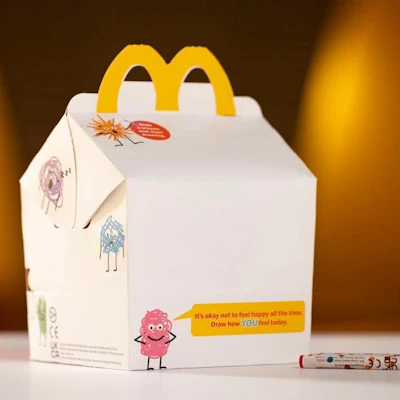
McDonald’s has introduced a limited-edition redesign of its Happy Meal packaging in the United Kingdom and the Republic of Ireland as part of a collaboration with BBC Children in Need. Departing from the standard red design, the new boxes are plain white and intended to act as a drawing canvas for children, under the theme “draw how you feel”. The initiative is based on findings from commissioned research indicating that 42% of children aged five to ten in the UK struggle to talk about their feelings with adults, yet 73% feel more comfortable expressing themselves while drawing. The packaging aims to foster emotional expression and open conversations within families through creative engagement. Supporting resources are available via the McDonald’s Family Hub, offering guidance to families in understanding children’s emotions. Nearly four million of these redesigned packs will be distributed through restaurants and McDelivery services.
Voice technology brings accessibility by reading aloud the ingredient lists and nutritional information of Nestlé’s entire portfolio of approximately 1,200 products.ThePackHub
Nestlé Brazil's app enables audio access to food labels
Nestlé Brazil has introduced an accessibility initiative called Labels that Speak, designed to make food product information accessible to visually impaired and illiterate consumers. Developed in partnership with the Brazilian startup Alia Inclui and supported by the Dorina Nowill Foundation, the project centers around a smartphone application that uses voice technology to read aloud the ingredient lists and nutritional information of Nestlé’s entire portfolio of approximately 1,200 products. Users can operate the app through voice commands, locate barcodes easily, and interact with a built-in AI chatbot that answers specific queries, such as the presence of allergens like gluten or lactose. The app also includes navigation features that allow users to skip or focus on desired parts of the content.
The change in packaging led to improved palletisation, increasing the number of bottles per pallet from 500 to over 1,000.ThePackHub
SmartMouth's dual-chamber bottle redesigned to improve efficiency
Packaging firm TricorBraun, based in the United States, has collaborated with oral care company SmartMouth to redesign its distinctive dual-chamber mouthwash bottle, addressing user experience and supply chain challenges that emerged over the product’s lifecycle. The companies have partnered for over 30 years, with TricorBraun providing ongoing design, engineering, and manufacturing support. The updated design responds to consumer feedback highlighting usability issues such as the complexity of accessing the product and inconsistent dispensing caused by limited airflow, often referred to as “glugging.” The redesign process included narrowing the bottle base, which enabled retailers to place three bottles per shelf row instead of two, enhancing space efficiency. In addition, TricorBraun developed a custom flip-top cap for the dual chambers that allows users to open each side independently while ensuring airflow during dispensing, which results in a smoother pour. The design was validated at TricorBraun’s lab in Oak Brook, Illinois, through testing for leak resistance, pour control, and secure transport. The changes led to improved palletisation, increasing the number of bottles per pallet from 500 to over 1,000, helping to reduce logistics costs and enhance supply chain efficiency.
 Voice technology brings accessibility by reading aloud the ingredient lists and nutritional information of Nestlé’s entire portfolio of approximately 1,200 products.ThePackHub