Kerry Turns to ‘Cruise Control’ Technology to Optimize Dryer Performance
To support its quality, efficiency, and sustainability goals, Kerry implemented model predictive control technology at its Rothschild, Wis., facility. The system helped improve efficiency at the site, solving dryer blockages that had caused about 145 hours of lost production in 2023.
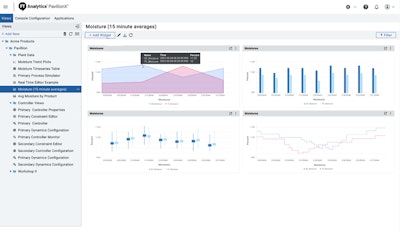
The Pavilion8 MPC can monitor machine data over time and compute the settings needed for optimal performance.
Rockwell Automation
No food producer wants to leave efficiency on the table, and adaptability is key to reliably finding those efficiency wins.
Sustainable nutrition company Kerry demonstrated this when it implemented Rockwell Automation’s FactoryTalk Analytics Pavilion8 Model Predictive Control (MPC) on evaporators and spray dryers at its Rothschild, Wis., facility, Kerry representatives explained at Rockwell’s Automation Fair in November. The software optimized spray dryer and evaporator performance for whey permeate production at the facility, helping to eliminate about 145 hours of lost production due to CIP each year.
Implementing the MPC enabled a 21% increase in spray dryer efficiency and better consistency between shifts, Aleisha Jaeger, Senior Director of Engineering for Foundational Technology at Kerry Group, shared at the event. “Calculations were conservative. We had an ROI of five months, versus an anticipated two years to get this online,” she added.
How the MPC works
An MPC acts as a “cruise control” applied on top of existing regulatory control systems, computing the optimal settings to accrue performance over time, and applying those settings to control systems, according to Scott Jost, Director of Industrial Data Science for Kalypso: A Rockwell Automation Business.
An MPC balances three types of variables, Jost explained. They include:
Controlled variables which are set to hit specific targets.
Manipulated variables that operators typically adjust, like temperatures or flow rates.
Disturbance variables, which impact the process but can’t be moved, so they must be accounted for.
The MPC predicts the settings needed to improve machine performance, and can apply them to optimize operations.Rockwell Automation“We use a solver to predict the best future path, how to move from where we are now to where we want to be, to get things into a more economic position,” said Jost. “The model predictive control actually coordinates all of these things in concert to basically push us toward the most economical operations.”
Kerry first started working with Rockwell’s MPC technology with a pilot in 2022, Jaeger said. “From there, we did a rack and stack of our remaining dryers in North America, and decided which ones would be best suited for this after the pilot. We looked at things like operations, duration, age, infrastructure, profitability, margins, and a handful of other metrics, and Rothschild provided the best opportunity,” she said. Implementation at the Rothschild facility began in early to mid 2024, with full results realized by early 2025.
From blockages to consistent performance
As a leader in sustainable nutrition, Kerry has strict standards around conserving energy and water, and reducing or eliminating waste, and invests heavily in solutions that will help meet its goals. Kerry upgraded its Rothschild facility in 2024, with improvements focused on enhancing food safety and employee welfare spaces. Jaeger attended the facility's reopening (right).KerryOne of the reasons Kerry chose its Rothschild facility was due to chronic spray dryer blockages and lump-outs throughout the year, amounting to about 25 incidents in 2023. Those blockages were the source of the estimated 145 hours of lost production time due to CIP, as each dryer lump-out resulted in a CIP lasting about eight hours, explained Alec Johnson, Process Tech Engineer at Kerry.
“We also noticed looking at the historical data that was pulled for Rockwell, that the dryer was being run at the same rate in the summer that it was in the winter,” added Johnson. “We all know how many differences there are between summer and winter, and [the Rothschild facility] could’ve been running at a much higher rate during winter.”
During implementation, Kerry and Rockwell evaluated all parts of the operation that could act as a bottleneck for performance gains. “We noticed the evaporator and speed of the dryer had constantly changing variables, which would then affect the annual operating hours (AOH) and feed rate of the dryer,” Johnson said.
Rockwell and Kerry conducted a benefits analysis based on historic data and potential improvement points and landed on a 0.4% uplift for the evaporator and 3.1% uplift for the spray dyer, Jost said.
“What we were really trying to do was shrink the variability, and that gives room to adjust targets closer to more optimal constraints of higher production,” Jost said.
Installing the MPC brought benefits across several factors, including:
Improved product quality and less variability. “Some of your key parameters like finished moisture percent, density, things like that – with MPC you have that controlled variability between shifts, so operators aren’t coming into the next shift and changing set points. It just runs the same, shift to shift, week to week,” Johnson said.
Minimized energy consumption. “In the summer months, you may have a constraint on your packaging side or your upfront side. Depending on what your constraint is, MPC will run the dryer to that bottleneck,” Johnson said.
More operator time on the factory floor. “This is a big one, especially with all the spray dryer safety procedures,” explained Johnson. He said when production rates increase during winter months, the MPC can cut back on safety monitoring time, allowing for more available time on the production floor. “They still have to do checks, but when they’re doing the dryer safety walk, they can have a pretty safe mind that the MPC is taking control; it’s not going to run outside its parameters and ensure the process remains safe.”
Minimized guesswork. The system allows Kerry to run at optimal performance considering any bottlenecks in the operation, placing less responsibility on operators to maximize efficiency. “When the MPC is on, you don’t have to worry about asking operators, ‘Why are you not at a certain rate?’ or ‘What’s your bottleneck?’ It takes some of the guesswork out of it, because you know the asset will run to whatever bottleneck it identified upstream or downstream,” Johnson said.Manufacturers can use the Pavilion8 MPC to identify and adapt to operational constraints.Rockwell Automation
Lessons learned and potential for expansion
Installing the MPC at the Rothschild facility took a measured approach for Kerry, first in deciding Rothschild was an ideal candidate for the software, and then in introducing the technology at the plant level.
“One of the biggest critical parameters was ensuring that it was site-led to ensure full buy-in,” said Johnson. “You want to ensure the site wants it and has a place for it. We explained the many benefits to the Rothschild facility, and they were very supportive.”
Senior leadership also needed to have a solid understanding of the benefits of MPC to make the project work.
“It was one thing to get the site team bought in, but another to sell it to senior leadership that this under-a-million investment is going to pay for itself, and why that’s the case,” Jaeger said.
Lastly, it was crucial to involve the operator early, so they have a full understanding of how it will help their day-to-day work.
“We got [operators] involved so early that they were excited about this, and after the first couple weeks of running, they hit some records," Jaeger said.
To consider MPC technology for more Kerry facilities, the company learned it would need to set pre-requisites for existing technology in the plant, meaning not every facility will be able to immediately adopt the technology.
The company evaluated its IT/OT networks across all facilities prior to this project and learned that its historian would need an upgrade before beginning the project. The upgrade was lumped in with the project, but it was one area that needed preparation for the new technology.
Remote access would also be a barrier to MPC adoption at some facilities. “We have to make sure folks can securely get into our systems,” Jaeger said.
Finally, though downtime is typically not part of Pavilion8 implementation, Kerry built in some leeway for downtime to test and configure the system.
“We have other facilities interested in the technology, and we are working through the requirements with them to determine which site will be the best fit,” said Jaeger.
 The MPC predicts the settings needed to improve machine performance, and can apply them to optimize operations.Rockwell Automation