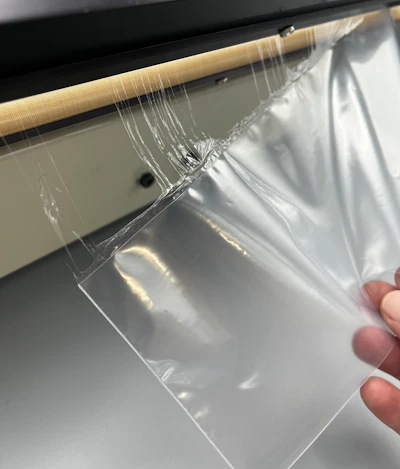
Unreliable temperature control often leads to overheated seals and damaged materials, highlighting the need for modern, feedback-driven solutions.
PackworldUSA
Key Takeaways:
· Impulse heat sealing enabled the manufacturer to dramatically accelerate production by reducing the sealing cycle from six and a half minutes to just six seconds.
· The technology eliminated the need for expensive FEP consumables, which translated into annual material savings of over $800,000.
· The shift also freed up more than 21,000 hours of cleanroom time, allowing personnel to focus on other areas of production.
In the world of medical device manufacturing, precision and efficiency are the name of the game. When a global medical device manufacturer chose to revolutionize its equipment, it was with those goals in mind.
The company was using convection reflow systems (paired with a custom FEP heat shrink film) to weld its catheter components. While the process was effective, it was resource heavy and time consuming, with each weld taking six and a half minutes and requiring a single use consumable costing $4 per cycle. With a production need of 200,000 cycles annually, the material costs added up to $800,000 each year, not including the labor and energy costs of long cycle times in a cleanroom environment.
Seeking to modernize this approach, the manufacturer turned to PackworldUSA to explore impulse heat sealing as an alternative.
“Convection reflow depends heavily on the heating element reaching its set‑point temperature and maintaining consistent airflow, making it more sensitive to variation. In contrast, Packworld’s impulse sealing applies heat only during the actual sealing cycle, eliminating the need for thermal ramp‑up,” explains the Senior Principal Manufacturing Engineer of the global medical device company. “Combined with resistance‑based process monitoring, this approach allows us to demonstrate process stability with significantly reduced variation.”
With the equipment switch, results were immediate and significant.
· Cycle times dropped from 6.5 minutes to just 6 seconds, enabling a 65x faster process.
· Consumable FEP film was eliminated, cutting material costs and improving overall sustainability by reducing plastic waste.
· This efficiency gain translated into more than 21,000 hours of cleanroom labor saved annually, freeing up personnel and production capacity.
· Beyond the financial savings and improved throughput, the switch to impulse heat sealing mitigated the company’s dependence on external suppliers. By removing the FEP consumable from the equation, the manufacturer reduced its exposure to supply chain risks.
The Evolution of Impulse Heat Sealing
Impulse heat sealing has come a long way in recent decades. Early machines operated on a fixed-power model, delivering the same amount of current to the heat seal band in every cycle. Over time, this approach caused the sealing jaws to retain excess heat, leading to over-melted plastic, seal failure, and invalid results. These machines lacked process feedback and weren’t capable of delivering consistent or certifiable results, making them unsuitable for industries requiring high repeatability like life sciences.
For this catheter application, Hoser says that it supplied custom tooling to hold the components in place, paired with a modular sealing press. PackworldUSA
The next generation introduced thermocouples to the heat seal band to create a feedback loop, but these sensors were too slow for fast sealing cycles and often imprecise due to poor installation or movement from operation. This led to under- or over-heated bands and unreliable sealing.
PackworldUSA’s approach represents the latest and most advanced stage in this evolution. By eliminating thermocouples to monitor temperature in cycles, their machines instead use a heat seal controller to both measure electrical resistance and meter power. This real-time calculation offers a direct correlation to temperature and enables an extremely fast and accurate feedback loop. The TOSS PIREG temperature controller enhances this precision further, taking 50 to 60 resistance-based temperature readings per second to ensure optimal sealing conditions are met consistently across every cycle.
Packworld machines are engineered to heat seal bands quickly with a benchmark goal heating to 572F (300C) in 400 milliseconds, in contrast to other impulse designs in the market which heat 100F per second or slower. Quick heating times enable faster cycle times and ensure consistent seal temperature throughout the cycle as plastics pull heat from the seal bands. This advancement in heat management has made impulse sealing not only faster and more energy efficient, but also fully validatable, therefore opening the door to wider adoption in sensitive and highly regulated production environments.
“Impulse is broadly applicable and can seal any film constant heat can, and may sometimes even produce better cosmetic results due to implementing a cooling cycle. It is possible to seal thick layers of films together or film can be sealed to rigid plastics as well,” explains Brandon Hoser, Business Development and Marketing at PackworldUSA. “We have been working through complex projects mostly focused in the life science industries for many decades and understand all of these nuances in design.”
Technology That Solves for Medical Manufacturing
Hoser says that PackworldUSA’s impulse heat-sealing technology offers benefits beyond speed and cost. It addresses a deeper set of needs specific to medical device manufacturing: process control, repeatability, and the ability to validate. In life sciences, manufacturers are often hesitant to change validated processes due to the regulatory burden of re-qualification. However, in this case, the performance improvements were so clear, and the solution so precisely controlled, that the investment in change was justified.
“Because impulse sealing uses a heat band in direct contact with the material, it delivers more consistent and repeatable seal strength and uniform seal lengths. In contrast, convection reflow processes are highly sensitive to airflow rate, and any fluctuation directly affects seal performance,” says the engineer of the medical device company.
Unlike constantly heated systems that require 15 to 20 minutes of preheating, impulse heat sealing equipment is ready to run in under a minute. It also supports a cooling cycle after the sealing temperature and dwell parameters have been achieved, which is critical for producing hermetic seals with materials lacking good hot tack properties. Some components require that cooling step for functional integrity, but even when it's not strictly necessary, it often produces a superior cosmetic finish. With impulse sealing, only a thin heat band, about the thickness of a razor blade, is energized, allowing the sealing area to heat and cool rapidly. A focused heating area at sealing temperature only when needed reduces energy consumption and keeps tooling at lower temperatures for quicker handling if the need should arise. The precision of this method supports better overall product quality while making the process highly adaptable for medical device manufacturing.
Looking at the ROI
While determining the exact ROI on a project of this scale is difficult, the engineer at the medical device company says that the measurables include two specific things.
“Cycle time reduction and, for this specific application, the elimination of FEP heat shrink, which was a manufacturing consumable.”
As the Senior Principal Manufacturing Engineer further explains, “We were able to eliminate the need for a custom FEP heat shrink consumable in our process. This allowed us to remove the dependency on an external supplier that can have supply chain risks. In addition, reducing the cycle time from over 6 minutes to 6 seconds gives our manufacturing facility peace of mind knowing this equipment has no impact on the overall capacity of the manufacturing line.”
The switch to impulse heat sealing also delivered sustainability benefits that aligned with the manufacturer’s long-term goals. By eliminating the use of FEP (a fluoropolymer material under the PFAS umbrella) the process significantly reduced plastic waste and minimized the environmental impact of production. The system’s low-energy profile, driven by short heating times and rapid cooling, further reduced the overall energy footprint.
“What is not quantified is the time savings in a cleanroom environment and what that savings equates to in dollars,” explains Hoser. “They may have the ability to produce more product within the same time frame or free up operators to work on other value-added activities. The customer notes the ability to run multiple products in one cycle, which is very possible in their application. This would add further efficiencies if the need arises.”
For this catheter application, Hoser says that it supplied custom tooling to hold the components in place, paired with a modular sealing press. After testing the setup on PackworldUSA’s in-house machines, the customer quickly moved forward with purchasing three full systems, which are deployed across three uniquely located facilities across the globe. Encouraged by the results, the company is actively pursuing implementing the technology in other parts of its manufacturing process.