There’s likely not a day that goes by that you won’t see something about a GLP-1 drug via a television commercial, a celebrity getting slammed on social media, or even brought up by a friend over dinner. The use of the drug is exploding for weight loss (and diabetes), and the food industry is noticing the shift in trends.
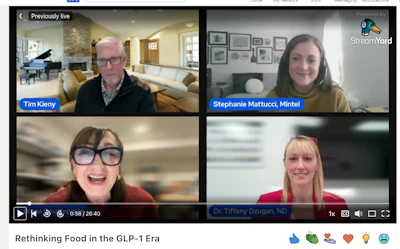
To address this head-on, TC Transcontinental Packaging hosted a recent Linkedin Live on the topic of GLP-1s and how the rise in the drug use is impacting consumer appetite, spend, and as such, packaging sizes.
Diana Courtepatte, Director of Marketing, TC Transcontinental Packaging, spoke with Dr. Tiffany Dzugan, ND, Healing Roots Chiropractic and Wellness Centre, Stephanie Mattucci, CFS - Principal Strategist, Food Science, Mintel, and Tim Kieny, VP of Sales & Marketing, TC Transcontinental Packaging. The live session was titled, “Rethinking Food in the GLP-1 Era: How appetites, spend, and pack sizes are shifting, and what brands should do now.”
How GLP-1 is changing consumer behavior
Not surprising, GLP-1s are a huge force in the pharmaceutical industry. TC Transcontinental Packaging reports that 45% of U.S. adults are using, have used, or have expressed interest in GLP-1s. And as such, this use is changing how Americans eat and shop. Most notably, the company reports that overall household food spending has dropped by 6-11%.
“We are officially in the GLP-1 era,” says Stephanie Mattucci, CFS, Principal Strategist, Food Science at Mintel. “Obesity rates are leveling off and are dipping for the first time in over a decade, and weight loss medication could be part of that reason.”
Mintel data shows that GLP-1 use is climbing fast, with 18% of consumers using them in 2025, up from 12% in 2024. And industry experts like Mattucci predict that more people will jump on board.
“Advancements with pill versions, generics on the horizon, better access, lower cost…. more growth is inevitable,” says Mattucci.
While attention in the media is on the weight loss side of the drug, GLP-1s remain an important drug for diabetes treatment. In fact, the World Health Organization (WHO) has added GLP-1s to the list of critical medicines for diabetes treatment.
While 18% of consumers using a GLP-1 may seem low, Mattucci points out that 82% of Americans are managing their weight in some way, so food labeling and packaging that speaks to this trend is a must. Early studies reveal that GLP-1 users spend less on food, especially indulgent items like potato chips and sweets. Instead, the industry is seeing an increase in demand for nutrient-rich foods, like fruit, vegetables, and high-protein categories.
As Dr. Tiffany Dzugen describes, “GLP-1 users have less appetite and food noise is much less, so they’re eating less out of boredom, or for comfort.”
Portion sizes are also smaller as a result. But she laid out that while users are eating less, what they are eating becomes much more important. Patients are still making better choices, exercising, and are looking for more nutrient-rich food to properly fuel their bodies and maintain muscle.
How food brands must respond
“Nutritionally, brands should be prioritizing protein, and fiber to support digestion and stay full on less. Lean, high-quality ingredients and cleaner labels are on the rise,” says Dzugen.
Not only is GLP-1 use impacting food choice, but consumer spending, too. But it’s not the only factor— Mattucci points out that inflation is hitting consumers hard too. “Food prices in August 2025 were 3.2% higher than a year ago. But are 18% higher than 2022. Consumers are rethinking how to spend money on food.”
With consumers changing how they eat and how they spend their money, Tim Kieny of TC Transcontinental Packaging says that brands and their packaging need to keep up.
“Brands should focus on four key areas: portion size, clear labeling, functionality, and sustainability. It’s about meeting consumers where they are,” says Kieny.
· Portion – smaller sizes, single-serve packages, smaller bowls and cups.
· Clear labeling- shoppers make decisions fast and they’re scanning for nutrient dense options, so packaging should communicate important stuff quickly
· Functionality- packaging can support mindful eating like resealability options, visibility windows, and other convenience features.
· Sustainability- moving to smaller portions to reduce waste, recycle-ready and right size packaging.
The experts agree that brands need to focus on communicating value to consumers to get their attention and should put “nutritional quality on the spotlight.” They also agree that there is a buzz around ultra-processed foods and what that means for health, so packaging needs to answer the question, “is this worth it?”
“Packaging can support consumer behavior by keeping healthy messaging simple. Nutrient density and satiety will resonate strongly in 2026," says Mattucci.
She also said that calling out protein and fiber are key as consumers look for those ingredients to mitigate common side effects like GI issues and muscle loss. But packaging plays a larger role in keeping food fresh and protected. It also can help with portion control for conscious consumers.
“Portion control packaging has been around for a long time when it comes to weight management, but the language is changing. Portion control is becoming portion wisdom,” says Mattucci.
GLP-1 use or not, today’s consumers are looking for food brands (and the packaging) to help them make better food choices.
“Brands have an opportunity to help consumers on their weight loss journey,” says Mattucci.
Through clearer labeling, the right sized packaging, and calling out nutrients, brands can get noticed by GLP-1 users (and other weight-conscious consumers) and earn a portion of their reduced spend.