Nature Plus Eggs is an Elmira, Ontario-based company that sources eggs from small-scale farmers in its region and distributes them to supermarkets chiefly in southern Ontario. As it makes clear on its Web site, the eggs it provides, many from families that have been farming for generations, come from hens that are never fed antibiotics or hormones.
Not long ago the firm was able to meet its requirements with an egg sorting and packaging system capable of 40 cases/hr (where each case holds 360 eggs). But steady growth led to a new and larger facility and a system capable of 150 cases/hr.
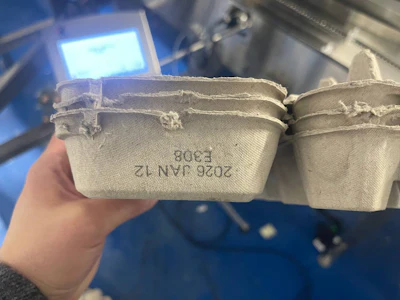
As we’ll see shortly, the highly automated and robotic system guides eggs into eight lanes. Each lane denests molded pulp cartons and feeds them into an egg depositing station. Essential to each lane, of course, is the ability to print lot and date code information on each carton just after denesting and before eggs are deposited. For this part of the operation Nature Plus turned to RNJet. Nature Plus is using the RNJet 100, a high-resolution small-character DOD printer based on a print engine from Xaar.
According Nature Plus owner and founder Josh Weber, carton coding is running every bit as smoothly and reliably as he wants it to. As for how he wound up selecting RNJet as a supplier, location had a lot to do with it. He puts it this way. “I called several suppliers and when I called RNJet, they said we’re located two hours from your plant. We’ll be right there.” Shown here is one of eight small-character ink-jet printers operating on the highly automated egg cartoning line at Nature Plus.Nature Plus
Reusable flats
Eggs arrive from the farms in reusable compartmented plastic flats. The flats are stacked 6-high and each holds 30 eggs. An operator places a stack of flats on the initial infeed conveyor of the automated grader/washer/inspector/cartoner supplied by Yamasa. Next comes the following:
• a robotic pick-and-place system mechanically picks two flats at a time from the stack of six flats and places the two on a conveyor
• two more robotic pickers pick all 30 eggs from each flat and place them on a parallel conveyor running in the opposite direction; empty flats are neatly stacked for subsequent removal
• eggs are conveyed through a washing unit and then through a dryer
• eggs pass through Yamasa’s Model SV150 automatic egg candling unit that uses vision inspection to identify any egg that is either dirty or leaking so that they can be rejected from the flow of good eggs Part of the Yamasa system is a pick-and-place robotic arm that removes eggs from the reusable plastic flats.Nature Plus
• eggs pass through another vision system that detects any egg with blood inside and flags it for ejection
• eggs pass through a final inspection system that uses ultrasonic sensors to identify any egg with a hairline crack that can’t be seen by the naked eye and flag that egg for ejection
• eggs are weighed and sorted into jumbo, extra large, large, etc.
At this point the eggs reach eight lanes running perpendicular to and below the flow of eggs. Each lane is equipped with a mechanical denester that feeds nested molded pulp cartons one at a time so that eight parallel lanes of cartons are now moving beneath the flow of eggs. Right after each denesting station is an RNJet ink-jet coder that puts lot and date code onto the side of each carton. All that’s left is for the cartons to pause briefly as 12 eggs are gently dropped inside. Then a mechanical tucker closes the carton top and finished cartons are conveyed to manual case packing.
“The expansion to a new facility was essential,” says Weber as he looks back at how far the firm has come. “We couldn’t keep up anymore.”