Inside Walmart’s e-commerce fulfillment centers, packaging is becoming more automated, more data-driven, and more tightly integrated into the retailer’s broader fulfillment strategy. As part of a multi-year agreement, Walmart is deploying Ranpak’s AutoFill automated void-fill and case-closing system across its five Next Generation Fulfillment Centers, which have been designed specifically to support high-volume online order fulfillment.
The rollout follows an initial pilot deployment of the AutoFill at Walmart’s McCordsville, IN, Next Generation Fulfillment Center. The system automates a traditionally manual end-of-line task, using AI to measure empty space in each case, dispensing the precise amount of paper-based void fill, and closing and sealing the case in a continuous process.
“At Walmart, we are constantly seeking solutions that increase speed of service for our customers and simplify work for our associates,” says Vik Gopalakrishnan, SVP, supply chain automation engineering at Walmart. “Ranpak’s AutoFill system offers us a meaningful way to reduce packaging waste and get our products into our customers’ hands faster.”
Walmart plans to expand installations of the AutoFill to its Next Generation Fulfillment Centers in Greencastle, PA, Joliet, IL, Lancaster, TX, and Stockton, CA, in addition to McCordsville. Installations are underway as part of a multi-year phased rollout.
From pilot to platform
Walmart’s Next Generation Fulfillment Centers are designed to increase speed to customers while simplifying work for associates. Highly automated by design, the facilities are a key part of Walmart’s strategy to support e-commerce growth. Combined with the company’s traditional fulfillment network, the Next Generation Fulfillment Centers allow Walmart to reach 95% of the U.S. population with next-day or two-day shipping.
McCordsville was Walmart’s first opportunity to evaluate how the AutoFill performed at scale within its Next Generation Fulfillment Center environment. According to Walmart, the deployment functioned as a test-and-learn pilot, allowing the company to validate throughput, reliability, and material use under real operating conditions.
“McCordsville was the first to deploy AutoFill as part of a multi-year collaboration with Ranpak,” Gopalakrishnan says. “This initial implementation served as a pilot to validate performance during peak periods. The results exceeded expectations in speed, efficiency, and sustainability, paving the way for expansion to four additional facilities.”
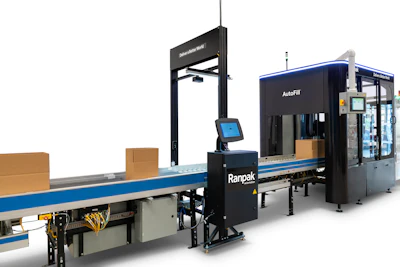
AutoFill is designed to operate continuously, filling and closing cases at a speed of nine cases per minute. The system relies on machine vision, electric servomotors, and an integrated conveyor to handle the random box sizes commonly seen in e-commerce fulfillment.
Once items are placed into a box, the AutoFill measures the remaining void space using its Decision Tower, dispenses the paper filler, and applies tape to close the case before it moves downstream.
 The DecisionTower adds an AI-enabled layer of intelligence to the packaging process. Using a combination of 2D and 3D computer vision supported by AI, it captures the dimensions of each case and its contents before void fill is dispensedRanpak
The DecisionTower is a key component of the system, adding an AI-enabled layer of intelligence to the packaging process. Using a combination of 2D and 3D computer vision supported by artificial intelligence, the DecisionTower captures the dimensions of each case and its contents before void fill is dispensed. The system identifies mispacked or out-of-spec boxes and can reroute them to a manual triage lane, helping prevent issues from moving further downstream. It also captures order-level data that supports order verification, loss prevention, and ongoing analysis of packaging quality.
When paired with AutoFill, the DecisionTower ensures that every box receives the optimal amount of paper-based void fill. According to Gopalakrishnan, the system reduces paper use by up to 20% by eliminating unnecessary filler, while also reducing damage associated with underfilled boxes.
Labor shifts rather than labor cuts
Ranpak has positioned the AutoFill as a way to reduce labor requirements at the end of the packaging line, noting that automating manual void filling can allow one to three full-time-equivalent roles to be reassigned for other tasks.
Walmart describes the impact less as labor reduction and more as a shift in how work is performed. "For Walmart's operations, we see automation as a way to improve the associate experience and enhance customer service," Gopalakrishnan says. "Thanks to this technology, associates who previously focused on repetitive manual packaging tasks now have the opportunity to support other areas of operation and further exceed customer expectations."
The AutoFilll's interface is designed to be intuitive. According to Gopalakrishnan, Walmart operators need only basic training to handle monitoring and material reloads. "Reload frequency varies depending on order volume, but the process is designed to minimize interruptions to production flow," he adds.
Supporting a broader right-sizing strategy
AutoFill is not a standalone initiative. Walmart also uses Ultra5 machines from Packsize to produce right-sized corrugated cases on-demand within its fulfillment centers. According to Gopalakrishnan, the AutoFill complements these systems by automating filler dispensing and case sealing once the appropriately sized case is formed. “The AutoFill ensures precise filler amounts and automates box closure, complementing Walmart’s broader right-sizing strategy to minimize waste and shipping costs,” he says.
Together, these systems support Walmart’s efforts to reduce packaging waste while maintaining product protection during shipment. As the AutoFill machines are deployed across its additional sites, the retailer is continuing to refine how automation fits into its end-of-line packaging operations, balancing speed, material use, and labor efficiency. PW