Offline 2D Code Aims to Put Full Directions for Use On Pack
A proprietary, offline 2D barcode aims to embed full directions for use directly on FDA-regulated products' packaging, positioning accessibility and QA verification as the next frontier in 2D adoption. It will do so alongside, not instead of, GS1 Sunrise 2027 standards.
A sample HD InfoCode+ symbol printed on cartonboard illustrates the proprietary, high-density 2D format engineered to store complete instructions for use within the printed code itself.
Gary Parish, HD Barcode
As brand owners accelerate their transition to GS1-compliant 2D barcodes ahead of Sunrise 2027, most implementation conversations revolve around retail point-of-sale readiness, inventory visibility, and supply chain efficiency. But one Florida-based technology provider is advancing a different vision for 2D codes—one centered not on checkout lanes, but on consumer accessibility.
HD Barcode LLC’s HD InfoCode+ is a proprietary, high-density 2D symbol designed to embed full directions for use directly into packaging artwork. Unlike QR codes or GS1 Digital Link implementations that typically point to web-hosted content, HD InfoCode+ is engineered to function offline.
Parish also argues that QR-based systems introduce risk because they rely on external URLs that can be redirected or overlaid with fraudulent codes. By embedding the full text directly within the symbol, he contends that the system reduces dependence on web-hosted content and the possibility of malicious redirection.
“The code is a memory stick on paper,” says Gary Parish, managing director, HD Barcode. The company claims that the symbol can store up to 225 times more data than a standard QR code of comparable physical size and error-correction level, though it has not published independent side-by-side benchmarking data.
But the memory stick analogy and description reflects the company’s core premise: instead of linking outward to information stored online, the symbol itself contains the full text of directions for use. Parish frequently contrasts the system’s embedded architecture with cloud-based models that rely on persistent connectivity and external hosting. If the complete, FDA-approved instructions are embedded directly in the symbol, a consumer (or quality assurance inspector) can retrieve the exact language approved at the time of printing without relying on internet connectivity.
Parish sees pharmaceutical labeling, where artwork errors can trigger recalls or regulatory action, as the most immediate application.
An Accessibility-First Emphasis
Parish positions HD InfoCode+ primarily as an accessibility solution for blind, low-vision, reading-challenged, and Deaf consumers.
“With HD InfoCode+… every patient can safely understand their prescriptions once manufacturers adopt this standard with FDA support,” he says.
The symbol can be scanned using a dedicated smartphone app that converts embedded text to audio. For individuals without smartphones, the company proposes PC-based scanning stations in pharmacies or retail environments. HD Barcode also describes the ability to link to in-store American Sign Language (ASL) video support.
Parish argues that manufacturers have not fully addressed ADA accessibility expectations on packaging and sees embedded directions for use as a way to supplement printed labeling.
The system has not been formally reviewed or endorsed by the FDA, and HD Barcode characterizes it as FDA-untested.Demonstration graphic from HD Barcode illustrates how HD InfoCode+ embeds full directions for use within a high-density 15 mm × 30 mm symbol, alongside a secondary “SmartCode” layer designed for anti-copy and authentication features. Gary Parish, HD Barcode
Regulatory Verification and Offline Comparison
Beyond consumer accessibility, Parish frames HD InfoCode+ as a quality-control tool for regulated industries such as pharmaceuticals.
He points specifically to FDA regulation 21 CFR 211.122(a), which requires manufacturers to establish written procedures for the receipt, identification, storage, examination, and approval of labeling and packaging materials before use. The regulation requires proofing incoming labels against the approved master labeling and ensuring that only correct versions enter production.
“FDA regulations require manufacturers to verify labeling before it reaches production. HD InfoCode+ allows that verification to happen directly and offline,” Parish says.
Using a PC-based reader, manufacturers can decode the embedded text and compare it against the approved regulatory document using a text comparison program. The goal, according to the company, is to confirm that the artwork precisely matches the master file before production.
The regulation itself does not prescribe barcode-based verification methods, and HD InfoCode+ has not undergone formal FDA review. Parish characterizes the system as FDA-untested, though the company reports that its verification software has passed manufacturer audits.
Where It Differs from GS1
Parish maintains that HD InfoCode+ represents a fundamentally different emphasis than GS1-based 2D implementations.
“In reality we are doing something entirely different than the GS1 code,” he says.
GS1 US frames the distinction more narrowly. Andrew Morehead, global standards director for GS1 US, notes that Sunrise 2027 is focused specifically on enabling the GTIN to be processed at retail point of sale via GS1 Digital Link URI or GS1 element string syntax within a 2D barcode. Accessibility use cases are not currently within Sunrise’s defined mandate, though GS1 standards provide infrastructure that brands can build upon.
GS1 permits proprietary 2D codes to coexist on packaging, provided they do not interfere with GS1-compliant symbols intended for retail checkout.
In that context, HD InfoCode+ would not replace GS1 standards but could theoretically operate alongside them, assuming packaging real estate and workflow considerations allow.
HD InfoCode+ is not the only technology exploring accessibility-driven on-pack symbols. Other smartphone-accessible, on-pack inclusive design technologies exist in this space. NaviLens, for instance, is another on-pack symbol that is not reliant on the internet. Kellogg's and Coca-Cola have experimented with the tech. Similar to HD InfoCode+, NaviLens requires users to download an app on to their smartphones that will use the device's camera to view and interpret the code. Zappar is another technology that does not require an app, rather it requires internet connectivity to function.
Packaging and Production Considerations
For packaging teams, the operational questions are significant.
HD Barcode indicates that implementation involves licensing fees that can approach six figures for larger product lines, along with optional reader stations for retail environments. The smartphone scanning app is free, according to the company.
In company demonstrations, the symbol measures approximately 15 mm by 30 mm (roughly 0.59 in. by 1.2 in.), small enough to fit on a folding carton panel while containing the full approved instructions for use. Because the symbol contains the text valid at the time of printing, post-approval label changes would require regeneration of the code and reintegration into existing validation workflows.
The company also describes optional embedded “SmartCode” layers that can incorporate encrypted authentication data and diversion-protection features, including micro-pattern variations designed to resist duplication. These claims have not undergone independent large-scale validation.
High-density encoding also raises considerations around print resolution, inspection systems, and potential impacts on production speed, particularly in high-throughput pharmaceutical environments.
A Parallel Path for 2D Codes
HD InfoCode+ does not position itself as a replacement for GS1 standards. Rather, it reflects a different priority: consumer comprehension and offline accessibility first, retail interoperability second.
Whether that approach gains traction may depend less on symbol capacity and more on how regulators and brand owners define accessibility requirements in the coming years. As 2D barcodes become standard on consumer packaging, questions about what information belongs inside the symbol—and who it is ultimately designed to serve—are likely to grow.
For now, HD InfoCode+ represents an early-stage attempt to expand the role of 2D codes beyond identification and into embedded instruction. As 2D symbols become permanent fixtures on packaging, the next debate may not be whether to adopt them, but what responsibilities brands inherit once they do.
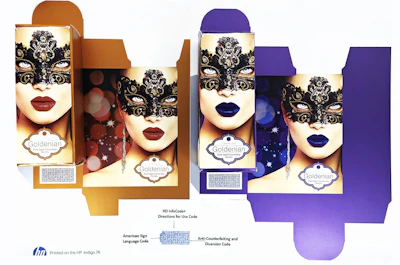
 Demonstration graphic from HD Barcode illustrates how HD InfoCode+ embeds full directions for use within a high-density 15 mm × 30 mm symbol, alongside a secondary “SmartCode” layer designed for anti-copy and authentication features. Gary Parish, HD Barcode