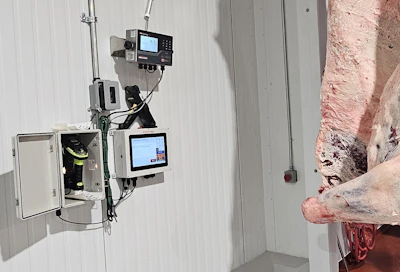
A VistaTrac TracBox computer at Bar-W's cold weight station automatically records carcass weights after time in a cooler.
Image courtesy of VistaTrac
Even at smaller protein processing operations, proper traceability can be a massive undertaking.
Manual tracking of inventory from animal receiving through regulatory checks and all the way to warehousing and shipping can take diligent record-keeping, and the accuracy of that record-keeping is vital to operational efficiency and preventing costly errors.
Bar-W Beef, a farm-to-table beef producer based in Nephi, Utah, avoided this traditional paper-based tracking as it began operations in September 2024, starting with a VistaTrac supply chain traceability system from day one.
“Traceability is one of the core pillars of our organization,” says Angie Reish, Assistant Plant Manager at Bar-W Beef. “VistaTrac allows us to confidently track not only our own beef but those of our custom processing customers.”
Bar-W considered a few options when deciding on traceability equipment, ultimately landing on VistaTrac as its partner in part due to the system’s module options, allowing the beef producer to track custom beef orders. The decision also came down to “[VistaTrac’s] familiarity with small processors and our challenges,” Reish says. “VistaTrac is complex enough for all our needs but diverse enough to be an asset in a smaller facility.”
How the VistaTrac system works at Bar-W Beef
The VistaTrac system at Bar-W Beef tracks product through every stage of processing, helping the company to handle both wholesale slaughter and custom processing orders with complete traceability. It consists of a series of TracBox computers and Zebra mobile scanners placed at key points in the production line and connected to scales Bar-W already had installed at the facility.
The TracBox computers, waterproof, touchscreen, and built with a plastic casing, are “a more affordable solution than the common stainless-steel computers you see in a production plant,” says Matt Schoneman, Vice President and Consultant at VistaTrac. “Especially when they have to buy a lot of stations.”
The system begins with a TracBox at live animal receiving, where an operator can record the vendor and number of animals dropped off.
Another TracBox is at the entrance to the kill floor, where an operator scans ear tags ahead of slaughter, “to make sure [Bar-W] knows exactly which [animals] are going onto the kill floor at exactly what times,” Schoneman says.
After slaughter, a TracBox is connected to a hot weight scale, automatically recording carcass weights before they head to the cooler. The computer also allows operators to digitally fill out the BSE checklist for each carcass, allowing for “fast record keeping in real time,” Reish says.
To ensure consistent compliance, the system only allows operators to print a carcass tag after the BSE checklist is complete, “so it eliminates the paperwork on the plant floor and makes sure they’re always meeting USDA requirements,” Schoneman explains.
After carcasses leave the cooler, they are moved to a cold weight scale also connected to a TracBox, automatically recording weights after some normal shrinkage from cooling. That computer also scans the carcass into the production batch, recording the lot numbers of each carcass to know exactly what enters the production floor and when.
A TracBox system with enclosed scanner (circled) is used for weighing and labeling product.Image courtesy of VistaTracThe carcasses are cut and processed, and sent to a packing station, including packing carts equipped with TracBox computers. “That’s where they’re boxing up meat for customers, weighing and labeling pieces and cases, and essentially producing inventory,” Schoneman says. “At the end of the day, they know that the meat in that box came from one of those carcasses that was scanned into the production room, so it’s full traceability.”
Once everything is packed, operators use mobile scanners for shipping and warehousing, further recording each case’s journey past the production line.
The QuickBooks connection
VistaTrac doesn’t just track inventory; it streamlines operations. It allows for real-time integration with QuickBooks or various ERP systems, to “bridge the gap between the plant floor and the office,” Schoneman explains.
The system is connected to Bar-W’s QuickBooks, so when a sales order is entered into the program, it automatically downloads into VistaTrac. From there, operators can print out pick slips and scan items into the order. Once everything is scanned, VistaTrac automatically sends ship weights back to the sales order and accounting system.
“We use QuickBooks online, and the connection with VistaTrac works well. Other than a few learning curves, the process has been great,” Reish says. “The pick slip process while filling orders eliminates billing errors and mistakes by nearly 100%.”
Learning the system and looking ahead
VistaTrac provides hands-on support throughout implementation, offering both remote and onsite training. The company also offers hardware installation and go-live consulting.
“A lot of times, I’m personally going onsite, and we’re working with your people on the plant floor at 6:00 a.m. or whenever they get started, and we’re really helping them go live and ensuring that they’re successful with the system,” Schoneman says.
That support helped Bar-W ramp up use of the system quickly. The company was 100% live on the slaughter side in a matter of weeks after installation in 2024.
Even with that quick startup, Reish acknowledges the system’s depth. “VistaTrac is a very robust system, and we still don’t use it to its full capabilities, but our staff has learned its operations and troubleshooting really well,” she says. “We hope as we continue to grow and mature as an organization, we can continue to optimize more features.”
Potential future optimizations and additions include a recipe module and expanding use of raw materials inventory tracking, Reish says.
For other processors considering the system, Reish offers straightforward advice to “designate one or two people to become experts at using the system. It is a complex system with so many options.”