Tariffs & Trade Uncertainty Drive Orion to Reshore Production
Facing tariff volatility and supply chain unpredictability, Orion Packaging Systems brought back production of its entry-level stretch wrapper to the U.S.
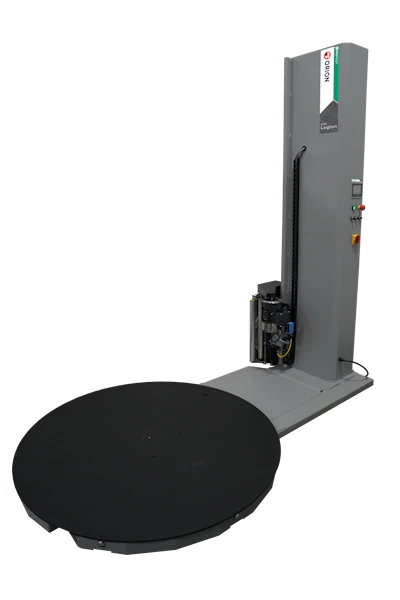
The new Flex Legion system replaces Orion’s imported entry-level stretch wrapper, providing manufacturers with a 100-percent U.S.-built solution.
Orion
One of the early stated goals of the current administration’s tariff strategy was to bring manufacturing jobs back to America via reshoring. While the validity of this goal remains in question, tariffs—which the Supreme Court just struck down as unlawful—continue to cause uncertainty and ongoing supply chain volatility. In one case, at least, the result of a year of tariffs was the reshoring of a product line for Orion Packaging Systems, a ProMach brand.
In early February, Orion announced it had brought production of its entry-level stretch wrapper back to the United States, replacing an imported model with the newly launched Flex Legion, a system that is 100% U.S.-designed, engineered, sourced, and built.
The move reflects how some OEMs are reevaluating global production models in favor of greater domestic control.
Tariffs shift the equation
Orion’s decision to reshore production was rooted in risk mitigation.
“We made the decision to bring our Orion Flex Legion stretch wrapper to U.S. production to gain tighter control over quality, lead times, and cost stability while reducing exposure to tariff volatility and overseas supply chain disruptions,” says John French, vice president and general manager of Brenton and Orion.
Tariff unpredictability has complicated long-term planning for both OEMs and their customers. Sudden cost increases on imported components or finished equipment are disrupting pricing models, delaying capital projects, and compressing margins. By domesticating design, engineering, sourcing, and manufacturing, Orion says it can stabilize pricing and better protect customers’ total cost of ownership (TCO).
Beyond tariff mitigation, domestic production offers operational advantages.
“Manufacturing Flex Legion in the U.S. allows us to standardize architecture across the Flex line, simplifying maintenance and reducing the number of unique spare parts our customers need to carry,” says Pat Pownell, director of sales at Orion.
Strengthened partnerships with U.S.-based suppliers, including Rockwell Automation’s Allen-Bradley for controls, further enhance familiarity and serviceability. “That consistency improves integration, troubleshooting, and long-term serviceability,” Pownell adds.
For end users, those benefits translate to less downtime and fewer unknowns, which is more critical than ever in an environment where labor is tight and throughput demands remain high.
Customers rethink global exposure
Orion’s reshoring move aligns with what it claims to see among its customer base: a deliberate push toward automation and supply chain localization.
“Our customers are making deliberate investments in automation to streamline efficiencies, stabilize costs, and improve overall operational performance,” says French.
In turn, by selecting equipment designed and built domestically, manufacturers can gain greater cost predictability and reduce exposure to global disruption.
Flex Legion supports that shift by helping companies transition from manual pallet wrapping to semi-automatic systems while maintaining domestic supply chain stability.
A close-up look at the S-Carriage Insta-Thread prestretch film carriage system.OrionThe machine features a heavy-duty steel structure, shares architecture with Orion’s broader Flex line, and includes an InstaThread™ carriage capable of delivering uniform 200% film pre-stretch—reducing film consumption compared to traditional entry-level systems. That combination of durability and efficiency reinforces the long-term cost control that manufacturers increasingly prioritize.
While reshoring can raise questions about labor and facility capacity, Orion says it approached the transition strategically. At a time when U.S. manufacturing faces workforce constraints, the company leaned on standardized architecture, cross-trained teams, and process efficiencies to internalize production without straining operations.
“Automation isn’t just something we deliver to our customers; it’s also embedded in how we operate as a company,” French says.
To accommodate the new product line, Orion restructured and optimized its workflow layout to create dedicated build capacity for Flex Legion while improving overall production flow. By leveraging existing infrastructure rather than expanding its footprint, the company positioned itself for scalable domestic growth.
For OEMs and end users alike, the calculus increasingly centers on stability: predictable costs, reliable supply, and tighter control over quality and service. As tariff exposure continues to influence sourcing decisions, more equipment makers may follow suit, trading overseas cost advantages for domestic resilience.