Modern Machinery Buyers Prioritize the Early Research Phase
From repeated brand exposure to AI-assisted research and equipment-in-action video, the early research phase has become the decisive battleground in capital equipment sales.
Modern buyers are not simply comparing machine specs. They are evaluating risk exposure, supplier stability, financial justification, and operational impact.
PMMI Media Group’s 2025 Buying Cycle Study
If you read my column in the Fall 2025 issue, you may recall we explored Part 1 of PMMI Media Group’s 2025 Buying Cycle Study. That research focused on what triggers machinery investment and how buyers evaluate suppliers.
Now, with results from Part 2 in hand, one overarching takeaway connects both studies:
The sale starts long before a member of your team meets with the buyer.
Part 2, based on nearly 250 verified end users with purchasing authority, confirms that today’s machinery buyers are forming opinions, building shortlists, and validating suppliers well before direct engagement with OEM sales teams. When paired with insights from Part 1, a larger pattern emerges: Buyers are more self-directed, more risk-aware, and more digitally driven than ever.
Credibility through repetition
One of the strongest findings in Part 2 is the importance of repeated brand exposure. More than 86% of buyers say it’s important to see a supplier’s solution multiple times before viewing them as credible. A single interaction is rarely enough to establish trust.
Part 1 reinforced this behavior. Buyers rely on a mix of trade shows, peer recommendations, vendor websites, search engines, and industry media during early research. No single channel dominates; rather, credibility is built through coordinated visibility across multiple touchpoints.
For OEMs, credibility is no longer earned in a booth or during a first meeting. It is earned through sustained presence: industry media exposure, strong search discoverability, consistent digital messaging, and strategic event participation.
More than 90% of buyers expect to evaluate equipment visually before taking a call.PMMI Media Group’s 2025 Buying Cycle StudyIf visibility creates awareness, seeing equipment in action drives qualification.
Part 2 revealed that 66% of buyers say video of machinery in operation is very important in the initial research phase, and another 26% say it is moderately important. That means more than 90% of buyers expect to evaluate equipment visually before they decide to reach out.
Video helps buyers determine whether a machine can solve their challenge and allows them to share that content internally with other stakeholders. In many cases, an entire buying team may decide to pursue—or not pursue—a supplier based on video content alone.
Part 1 supports this shift. When asked how vendors can improve the buying experience, buyers emphasized clearer demonstrations, better access to information, and easier evaluation tools. The equipment-in-action video addresses all three.
Video is no longer a marketing accessory. It is a primary qualification tool that can shorten sales cycles and improve inbound lead quality.
Part 2 also reveals an acronym that’s becoming part of our everyday language: AI.
Over 50% of buyers surveyed report using AI tools to summarize technical specs, find and compare equipment options, or uncover additional insights they wouldn’t have found on their own.
Although 26% say AI hasn’t impacted them yet, it’s clear buyers are increasingly using AI as a time-saving filter before engaging sales.
This aligns with Part 1 findings showing that buyers are heavily engaged in independent research through digital channels before contacting suppliers.
If your specifications, FAQs, and application descriptions are poorly structured or buried behind gated forms, they are less likely to surface accurately in AI-assisted searches. If you want to have a better chance of being discovered in AI responses, be sure your content is clearly organized, accurate, and written in natural language.
As AI has changed how buyers research, purchasing processes, and behaviors have also changed. When asked how purchasing processes have evolved over the past three to five years, over 38% of respondents said they now have greater scrutiny of supply chain risk, while 32% said they’ve increased reliance on online research, and 27% are analyzing ROI/payback windows more than before.
Buyers evaluate risk, not just machines
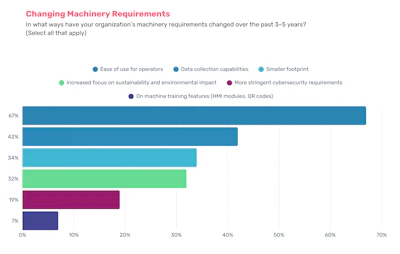
Speaking of building a business case for other stakeholders, in the study we asked, “In what ways have your organization’s machinery requirements changed over the past 3-5 years?
Ease of use leading the list is no surprise, and we’ve seen labor challenges and workforce turnover remain persistent operational pressures.
In fact, our Part 1 study showed that efficiency improvements, performance limitations, and new capability needs are primary drivers of equipment investment. When combined with workforce constraints, usability becomes central to value. Modern buyers aren’t only concerned with the efficiency of the machine, but now need to evaluate ease of use, integration with existing technologies, training and support, and ROI.
Marketing is the new front line
Let’s bring it all together. What does this all mean?
Marketing is no longer support for sales. It is a primary driver of capital equipment influence.
Buyers are beginning their research independently and need to see a brand and/or solution through multi-channel repetition to build trust. By the time a salesperson is contacted, buyers are often well into their evaluation process.
OEMs that coordinate their presence across industry media, events, digital platforms, and educational content will enter those conversations with more informed, more confident prospects.
The modern packaging and processing machinery buyer is not just comparing machines. They are evaluating risk, usability, integration, financial justification, and supplier credibility before the first meeting.
Part 2 of PMMI Media Group’s 2025 Buying Cycle Study showed that the early research phase is now the competitive battleground. And as our Part 1 study confirms, the suppliers who educate, demonstrate value clearly, and reduce friction throughout the process will rise to the top.
If you take anything from our 2025 Buying Cycle Study, take these three bullets:
Be visible early, often, and everywhere.
Show, don’t just tell. Video, video, video.
Help buyers justify decisions internally by showing value and transparency. It’s more than price and throughput.
Do that, and you won’t just be another name on a crowded supplier list; you’ll become the benchmark buyers measure others against. ν
PMMI Media Group is here to help your brand get the exposure it deserves, to an audience of engaged buyers looking for your solution. We’d love to partner and enhance your marketing strategy, deliver quality leads, and help you meet your 2026 goals.
 More than 90% of buyers expect to evaluate equipment visually before taking a call.PMMI Media Group’s 2025 Buying Cycle Study