The FDA paused FSMA 204 last year, but traceability and audit tracking remain a challenge for food processors as they switch to digital quality management solutions. The annual ETQ Pulse of Quality in Manufacturing Survey from May 2025 shows that 55% of respondents already use quality management software to manage quality processes, driven by goals such as increased compliance, reduced costs and reduced risk. Further, 60% of respondents cited plans to increase total spend on quality solutions in 2025.
With this backdrop, food processors are evaluating which type of quality management system is the right choice as regulations are tightening, reformulations are the new norm, new product launches are needed, and companies are adding more sites. Today’s quality solutions include off-the-shelf software, integration with manufacturing execution systems (MES), and inspection and detection equipment feeding these platforms.
Brands are feeling the pressure as reformulations accelerate due to the push by the FDA, consumers, and states toward natural colorants. In June 2025, global food and beverage corporation Kraft Heinz Co. announced it would not launch any new products in the U.S. with synthetic colors, effective immediately, and would remove dye-based colors from its U.S. product portfolio before the end of 2027.
“As raw material sourcing and growing regions continue to evolve, food manufacturers are increasingly challenged to understand and adapt to changing risk profiles,” says Chris Waibel, Product Manager for Tramp Metal and Automation, Industrial Magnetics. “In many cases, potential risks are not fully understood until they are identified through testing, audits, or real-world events, making it difficult to plan for every scenario in advance.”
With no defined FDA standards for natural colors, Sensient developed its own benchmarks for these types of additives. In a July 2025 interview with the Wall Street Journal, Paul Manning, Sensient’s CEO, said that approximately one in four raw materials it tests fails to meet the company’s safety standards.
The quality management design allows operators at Castle & Key to identify anomalies quickly,” says Taylor Sawyer, Director of Business Development at Gray AES. “Distilleries are in a unique position. They have to make decisions on a five-to-ten-year spectrum. They can't make a product today and sell it tomorrow.
The stakes are high, and quality software solutions are meeting customers where they live. Food producers, large and small, are struggling to staff engineering departments, so companies are choosing open-source software solutions that meet multiple objectives.
One example is QAD Redzone’s Connected Workforce platform, which provides visibility into four essential functions: productivity, compliance, reliability, and learning.
Palermo’s Pizza in Milwaukee, Wis., produces over 400 products and adopted Redzone’s compliance module for quality control. Inspection and detection are essential components for a company producing at that scale, and as the pizza producer grew, manual records and Excel sheets for auditing gave way to digital documents.
“In 2023, our Milwaukee facility decided to voluntarily go unannounced for our annual GFSI audit and for the last two years, we have received AA+ ratings,” said Melanie Braam, director of quality assurance for Palermo’s Pizza in 2024. “Our Jefferson facility will undergo their first unannounced audit next year, and with tools like clean, inspect, and lubricate (CIL), technology like RedZone, and detection equipment we can rely on, we are confident to set the AA+ goal.”
System software supplier Nulogy announced a solution combining its quality management system (QMS) and environmental, health, and safety (EHS) platforms, which fall under the company’s manufacturing operating system suite. The quality management offers standardization around quality processes, including digital documentation to stay audit-ready. The EHS software solution focuses on teams to manage safety programs, incidents, inspections, and environmental controls.
“With real-time data, we can provide immediate feedback on food safety and quality, and audit preparation is now effortless,” says Emily Nguyen, FSQA Director at Sysco. Sysco’s digital documentation initiative for food safety, quality, and supplier compliance spans across 180 sites.
Connected inspection and detection equipment
As inspection and detection equipment suppliers work with food producers, the focus is on connecting to quality management systems, as regulators want more. “Compliance is becoming far more forensic,” says Michael Pipe, Head of Product Inspection for the U.K. and Ireland at Mettler-Toledo. “Auditors no longer just want to see that an inspection system is installed; they want to see how it is managed day-to-day, how issues are identified and resolved, and how that evidence is captured.”
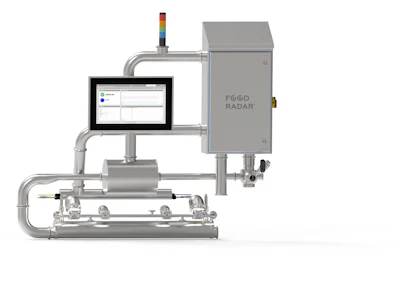
Regulators want more data as supply chains evolve to include more plant-based ingredients. A new microwave technology application from Sweden-based Food Radar Systems measures the dielectric differences between normal product and foreign material deviations in a pipe. This measurement identifies the usual suspects — metal and glass — as well as wood, rubber, soft and hard plastics, and less-dense foreign objects like pit fragments.
“From a food manufacturer’s perspective, the value of this compliance data goes beyond audit compliance,” says Emma Sydow, marketing content specialist at Industrial Magnetics. “When equipment is designed to generate actionable insights, such as how often contaminants are being captured or when cleaning is truly required, it allows quality teams to make more informed decisions.”
Integrating quality into MES and SCADA platforms
Recent announcements from big food show continuous investments in automation and data-centric technologies, and companies are evaluating integrating quality management actions into the MES and supervisory control and data acquisition (SCADA) levels. IT architects are now integrating compliance records, batch-process control information, and digital records for audits via historians, enabling operators to quickly gather real-time insights.
“When business grows, (plant) sites are added, products expand, regulations tighten, or new technology appears, the system that the company invested in can quickly grow to become a barrier,” said Doug Brandl, MES Solutions Engineer at SepaSoft, at the 2025 Ignition Community Conference. “This is why MES in some organizations is a bit of a naughty word.”
Gray AES, a system integrator, recently integrated historian modules and updated HMIs for operators to view historical data, trends, and projections for Castle & Key, a Kentucky-based bourbon distiller.
“The quality management design allows operators at Castle & Key to identify anomalies quickly,” says Taylor Sawyer, Director of Business Development at Gray AES. “Distilleries are in a unique position. They have to make decisions on a five-to-ten-year spectrum. They can't make a product today and sell it tomorrow.”
For this modernization project, Gray AES updated the color scheme for tablets and monitors while maintaining the traditional grayscale and bright red color contrast standards. The distillery relies on bright colors, such as red for alarms and minimal clutter, while the background is a bright, inviting teal. When activated, all valves, pumps, and motors turn white, signifying they are in line with the high-performance standard.
Today’s quality management technology, inspection equipment, and approaches are rapidly evolving to meet current production demands while also keeping an eye on the future of food and beverage plants.