Downtime, depending on its duration and cost, is a kiss of death for OEMs. The endgame has always been consistent: Build the most reliable machine, minimize stoppages, and your customer wins. But new research suggests that the paradigm is shifting.
According to the OEM Advantage Playbook, a global study of 500 OEM leaders across 17 countries commissioned by Rockwell Automation, the next generation of machine builders will differentiate themselves not by eliminating disruptions but by recovering from them faster.
The research highlights a growing performance divide between OEMs that have adapted to today’s volatile operating environment and those still relying on traditional approaches to machine design and operational strategy.
“The next era of OEM leadership won't be defined by who builds the most advanced machine,” the report notes. “It will be defined by who builds a business that delivers consistent performance despite workforce turnover, supply disruptions, and relentless market pressure.”
To understand what that shift means in practice, the playbook outlines five strategic behaviors shared by top-performing OEMs, from designing machines around recovery speed to embedding knowledge directly into equipment.
Recovery speed is new KPI
While it’s no revelation that downtime is costly, it’s still jarring to read just how significant the cost. The average downtime event lasts 40 hours and costs roughly $3.6 million, with every hour offline representing about $92,000 in lost revenue.
The biggest differentiator isn’t how often machines stop; it’s how quickly operations recover.
“Historically, OEM machine design has been rooted in maximizing operational uptime,” explains Steve Mulder, global OEM director at Rockwell Automation. “However, our research tells a different story, where downtime length is more important than frequency.”
Top-performing OEMs are restoring operations in 24 hours or less, creating a 16-hour recovery advantage that compounds into millions in preserved revenue for customers.
Mulder says achieving that level of resilience requires rethinking how machines are engineered.
“Instead of engineering purely for uptime, they should engineer for rapid diagnosis,” Mulder says. “That means embedding real-time diagnostic capabilities that can isolate failures fast, building machines that communicate what's wrong and where, and treating downtime data as strategic IP rather than operational exhaust.”
Workforce forcing design changes
Another driver reshaping OEM strategies is the growing instability of the manufacturing workforce.
The research found 35% of OEMs globally, and nearly half (47%) in the United States, identify employee turnover as their biggest barrier to achieving strategic goals.
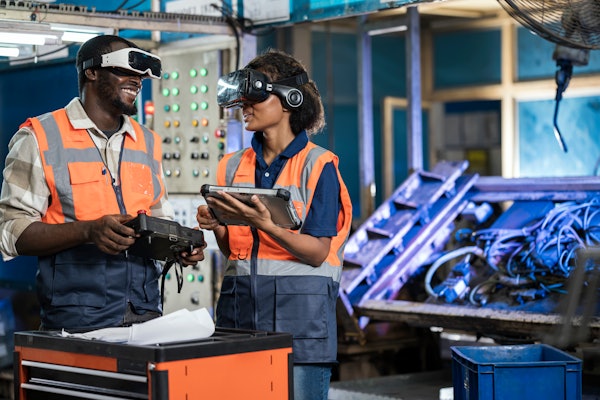
As a result, some machine builders are shifting from designing machines for experienced operators to designing machines that guide operators through tasks and troubleshooting.
“The principle leading OEMs are applying is simple: Assume people will leave and build systems that maintain performance across shifts regardless of who’s operating them,” Mulder says.
That shift is pushing OEMs to embed operational knowledge directly into equipment.
“Machines that guide operators through diagnosis and corrective action, using AI at the edge, dramatically shorten ramp-up time for new hires and reduce the adverse effects of turnover,” Mulder explains.
The result is what the report calls decision-guiding equipment: Machines that actively support operators rather than simply waiting for commands.
Strategic technology investments
Advanced automation like digital twins, collaborative robots, and AI-driven analytics are not new to the industry. But the playbook suggests the real difference between leaders and laggards lies in how they deploy those technologies.
Across the survey, 81% of OEMs say current market conditions are accelerating technology investment, while 77% view AI and machine learning as critical to designing quality into equipment.
The companies that successfully operationalize those tools share one common approach: intentional deployment tied to operational outcomes.
“Organizations that move from pilot to implementation share a common discipline,” Mulder says. “They deploy technology with intent tied to resilience outcomes, not as standalone innovation experiments.”
For example, using digital twins as resilience tools to simulate failure modes and operational scenarios is more likely to become embedded into everyday decision-making.
The most advanced OEMs are also closing the loop between machines deployed in the field and future machine designs.
“They use learnings from machines in the field, failure patterns, performance variance, quality outcomes, to improve next-generation designs,” Mulder says. “That creates a compounding advantage.”
Cybersecurity is a product requirement
The playbook also highlights a shift in OEMs' approach to cybersecurity and compliance. Rather than treating cybersecurity as an IT function or compliance task, leading OEMs are integrating it directly into machine architecture.
“Cybersecurity shouldn’t be thought of as a cost center or barrier to innovation or a gate that slows product development,” Smith says. “It should be treated more like functional safety; a design discipline baked into product architecture from the start.”
This shift is partly driven by evolving regulations such as the EU Cyber Resilience Act, which are raising expectations for machine builders across global markets.
Beyond compliance, cybersecurity is increasingly becoming a competitive differentiator.
“Buying decisions are increasingly driven by trust, resilience and compliance readiness,” Mulder notes.
Measuring success differently
Finally, the playbook suggests the most successful machine builders are changing how they measure performance.
While 92% of OEMs still track traditional production metrics such as yield and throughput, the most profitable companies are focusing on broader indicators tied to business outcomes.
According to Mulder, the two metrics that most consistently separate leaders from the rest are cost of goods sold and lead time.
“Rather than optimizing for yield alone, they treat speed, cost and quality as interconnected objectives and manage them as a system,” Mulder says.
Perhaps most notable is the rise of people-centered metrics, including employee safety, workforce satisfaction, and customer Net Promoter Scores.
“Dashboards that exclude these signals have a performance ceiling, and it's lower than most OEM leaders realize,” Smith says.
Shifting from machine to business performance
Taken together, the OEM Advantage Playbook suggests that the competitive landscape for machine builders is evolving.
The traditional focus on machine performance—speed, throughput, and uptime—is giving way to a broader definition of value centered on resilience, recovery speed, workforce adaptability, and customer outcomes.
The next generation of machine builders won’t necessarily build the fastest machines. They’ll build the most resilient businesses.