Nyco Products, a 106-year-old manufacturer of specialty cleaning chemicals, blends and packages products for facility maintenance, foodservice, HVAC, industrial cleaning, and other applications. With more than 300 formulations and nearly 900 SKUs, the Countryside, Ill.-based company has experienced steady growth in both product variety and production demands. As production volumes and product variety increased, ongoing labor challenges began to strain end-of-line operations, making manual palletizing increasingly difficult to sustain efficiently.
“Labor availability and significant turnover had been an increasing issue over the past three years,” says CEO Bob Stahurski. “As absenteeism increased, we were forced to utilize our upskilled labor for palletizing and stacking, resulting in increased costs and reduced productivity.”
According to the company’s internal assessment, turnover in stacking roles averaged roughly every 90 days, creating both operational inefficiencies and morale challenges.. As labor challenges intensified, the company began evaluating automation options for palletizing.
Tight footprint drives solution search
In Nyco’s search for an automated solution, equipment footprint was the top consideration. “We have some space constraints in our facility,” Stahurski explains. “We have five lines in one area that are fairly tightly placed together, so we were looking for a solution that would meet those needs.”
The company reviewed conventional robotic systems but found them difficult to accommodate within the available footprint. It needed a compact, flexible system that could handle high SKU variability without extensive guarding or line redesign.
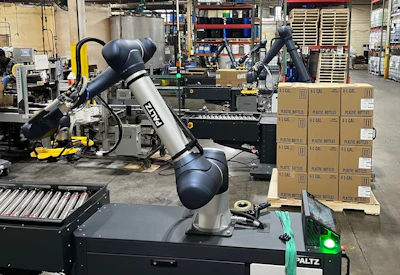
Nyco ultimately selected four IP54-rated PALTZ cobot palletizing systems from beRobox. Three of the systems are PALTZ.20C units equipped with Doosan P3020 cobots, featuring a 30-kg payload capacity and a maximum height of 92 in., including the pallet. The fourth is a PALTZ.17C palletizer, featuring Doosan’s H2017 cobot. The system has a maximum payload of 18 kg and a height of 60 in., including the pallet. Both the P3020 and the H2017 operate at 6.5 cycles/min.
All four cobots use end-of-arm tooling fitted with four vacuum cups for picking cases. The cups are divided into two independently controlled zones, which enables the cobot to handle different case sizes or patterns. All four also feature a skewed conveyor that presents cases in a consistent position and ensures accurate pick points for the vacuum EOAT.
The PALTZ system uses an HMI equipped with beRobox STACKiT palletizing software, which drives much of the system’s flexibility. Operators select preconfigured programs through the software interface to match each product and case configuration. “Operator changeover is very, very quick,” says Stahurski. “We use touch menus in our system, which gives us incredible flexibility at the end of the line”—a critical capability for managing hundreds of SKUs and frequent changeovers.
 This cobot palletizing system handles cases containing four 1-gal containers with precision, using vacuum end-of-arm tooling to ensure consistent placement and stable pallet builds across varying configurations.Nyco Products
The systems were deployed at the end of four production lines and run across two shifts with varying stack configurations. Their modular design allows Nyco to expand or adjust capacity without reworking the full line. “They are designed and deployed as standardized, self-contained palletizing modules that can be added, replicated, relocated, or scaled without redesigning the rest of the line,” Stahurski explains.
The compact footprint and collaborative design allow Nyco to operate without traditional guarding. “By controlling speed and height limitations, we are able to stay in compliance without the screen cages or light zone sensors,” says Stahurski.
Because of footprint limitations in the line length, the system’s dual-sided palletizing is critical. As Stahurski explains, one operator can clear pallets from several lines without any disruption in case delivery to the palletizer.
Fast rollout, low-risk adoption
Speed of implementation was also a key factor in Nyco’s decision. After Stahurski saw the palletizing system in operation in a YouTube video, the company moved from initial contact with beRobox to an in-plant demo within two weeks and had a unit running, with some “minor tweaking and menu adjustments,” within a day of arrival.
Stahurski says that very little end-of-line modification was required. Some power and air lines were preinstalled, and the PALTZ units were connected with a 3-ft roller conveyor from Nyco’s case sealers. This ease of integration allowed the team to quickly evaluate the system under real production conditions.
“It was supposed to be a one-week demo, but we negotiated one month so we could move it across multiple lines and see the integration with different packaging,” Stahurski says. That hands-on trial allowed Nyco to validate performance across its operations before committing to a broader rollout. Once the first unit proved successful, the company moved quickly to scale the solution.
The approach reduced risk while enabling rapid adoption. “Here we are, we’re about 60 days, maybe 70 days later from the day I watched that YouTube video, and we’ve got four units running highly functional in our facility today,” Stahurski says.
Tangible results across the operation
Since installation, Nyco reports an 11% increase in overall throughput. The system supports a range of pallet configurations, including 36 cases/pallet for gallon containers and 50/pallet for smaller formats.
Labor impacts have also been significant. The company has reduced headcount by six full-time equivalents and cut temporary labor by 61% year to date. At the same time, roles have shifted toward more skilled work. “We have significantly reduced turnover in the stacker role while transitioning that position into a higher-value cobot operator and setup role,” Stahurski says.
He emphasizes that clear communication and employee involvement played an important role in adoption. “There is an important factor to consider when introducing automation. Stating the project objective is critical,” he says. “Our employees brought the high turnover forward as an issue. Our machine operators embraced the technology very quickly because it increased productivity and reduced continual training as a result of the high turnover.”
Two employees have already moved into cobot programming and system oversight roles, reflecting a broader effort to upskill the workforce. “We’re on a directive right now where we’d like to get our lines running this year with one operator per line,” says Stahurski. “That’s a significant labor reduction so we can keep the best, upskill our workforce, provide higher wages, and create better efficiencies and consistency in our facility.”
The financial return has also met expectations. “Our estimated calculation is about a 1.88-year payback on the ROI on the equipment,” Stahurski says. “Anything under three years is the gold card for us, so 1.88 years was not a big decision for us in making this investment.”
Beyond labor, productivity, and ROI, pallet quality has also noticeably improved. According to Stahurski, pallet stacks are consistent every time. “The tolerances are very tight, and case placement is perfect on the pallets,” he says.
One unexpected benefit has been the visual impact of automation. “It’s a whole different tour now when we bring a customer or prospective customer through the facility,” Stahurski says. “Last week we had a customer bring 16 people from their company on an operation tour. Everyone loves to watch these cobots operate. It’s a statement of our continued commitment to investing in the facility and our business.”
Looking ahead, Nyco plans to expand its modular palletizing to other lines (it has eight in all) and is evaluating automated case packing, including cobot-based solutions. PW