This content was written and submitted by the supplier. It has only been modified to comply with this publication’s space and style.
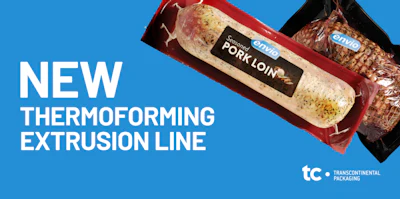
TC Transcontinental Packaging announced the installation of a new, state-of-the-art thermoforming extrusion line at its Tulsa, Oklahoma, facility, marking a significant expansion of its manufacturing capabilities and a strategic investment in the future of protein packaging.
The new downward water-quench extrusion line more than doubles TC Transcontinental Packaging’s thermoforming film capacity, strengthening the company’s ability to support the evolving needs of the meat, poultry, cheese, and broader protein markets. The investment enhances supply continuity while enabling the production of high-performance films with improved clarity, consistency, and forming performance.
“This investment underscores our long-term commitment to the protein industry and to the customers who rely on us every day,” said Rob Taylor, Director, Strategic Marketing, Meat, TC Transcontinental Packaging. “By expanding our thermoforming capacity and advancing our technical capabilities, we’re strengthening our ability to support customer growth, deliver dependable supply, and bring innovative packaging solutions to market. This new line reflects our confidence in the future of protein packaging and our commitment to leading in thermoforming technology.”
The downward water-quench extrusion process rapidly cools the film during production, delivering superior clarity, flexibility, and performance compared with traditional air-cooled or blown film methods. The technology enables the production of high-quality thermoforming films designed to create precise, durable packaging for a wide range of applications, including fresh and processed meats, bacon, sausages, poultry, and cheese.
The new line also expands TC Transcontinental Packaging’s technical capabilities by supporting broader film widths, improved material efficiency, and advanced structures such as peelable thermoforming films—enhancing convenience for consumers while meeting evolving packaging requirements. In addition, the platform strengthens the company’s ability to support recyclable structures and future sustainability initiatives as customer and regulatory expectations continue to evolve.