Artificial intelligence is becoming a practical tool in packaging development, helping companies work faster and make more informed decisions. In many cases, AI is used to quickly evaluate design options, refine graphics, or predict how a package will perform before physical testing begins. What is changing now is where AI is applied in the process, moving from late-stage refinement to earlier decisions that shape materials, performance, and sustainability outcomes.
At Hamburg-based one.five, AI is embedded directly into the process of matching products with materials that meet performance, sustainability, and economic requirements. The company uses its AI platform to assess how packaging materials behave in real-world conditions and how they align with regulatory and operational constraints. That approach is now on shelf in the form of a new recyclable, paper-based solution for ice cream bars made from one.five’s Hazelsun material.
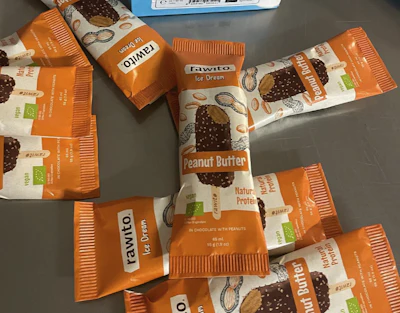
The packaging was designed for Rawito, a Czech producer of organic, vegan ice cream, using a data-driven development process applied to a category traditionally dominated by plastic. AI played a central role in balancing barrier performance, low-temperature durability, recyclability, and production efficiency.
From compostable foil to recyclable paper
Rawito first connected with one.five at the Biofach fair in Nürnberg at the beginning of 2025. The discussion centered on the pressure brands face to move toward genuinely sustainable packaging and the practical limits of existing solutions.
“Rawito’s consumers place a strong emphasis on sustainability and expect the packaging to reflect the same values as the product itself,” says Martin Weber, co-founder of one.five. “It was clear Rawito was looking for a next-generation solution that fit both the brand identity and the expectations of a highly sustainability-aware customer base.”
Says Ondřej Horáček, CEO of Rawito, “Our mission is to create ice cream indulgence at the highest level of quality, in harmony with nature. Our vegan ice creams are BIO-certified to European standards. Because packaging makes a decisive contribution, a 100% circular solution was important to us long before new reforms.”
At the time, Rawito was using a compostable foil wrapper for its bars. While the material represented a step away from petroleum-based plastics, both Rawito and one.five recognized the limitations of composting infrastructure for flexible packaging in Europe.
“This opened the door to explore whether a recyclable, paper-based alternative could be the next step, given that the recycling infrastructure for this material stream is far more established,” explains Weber.
Profiling ice cream through AI
Ice cream presents a demanding use case for paper-based packaging. The material must perform at low temperatures, tolerate condensation, and maintain barrier integrity without slowing line speeds or increasing costs.
 The packaging is printed at a Czech printing house using high-resolution offset printing. One.five supplies the flexible material directly to the printing partner to minimize transportation distances and emissions.one.five
“For ice cream packaging, we began by profiling the product and gathering data on aspects like shelf-life, compatibility with the customer’s preferred filling line, quality assurance tests that the material needed to pass, sustainability targets that needed to be met, pricing, supply chain, the list went on and was very comprehensive,” says Claire Gusko, co-founder of one.five.
She adds, “The material had to perform reliably at low temperatures and withstand condensation and temperature fluctuations, remain lightweight and run at the required line speed to maintain product economics, and achieve a high degree of recyclability at scale to ensure compliance with the incoming PPWR [EU’s Packaging & Packaging Waste Regulations] and allow the customer to optimize their EPR fees.”
 one.five’s AI platform evaluated and balanced multiple, often competing factors when developing packaging for Rawito’s ice cream bars. one.five
That data was then fed into Qt.Master (pronounced Quartermaster), one.five’s AI platform. “Qt.Master takes the detailed product profile and translates these into material requirements,” says Gusko. “It then evaluates all of the materials in our technology repository to identify those that match the requirements the most.”
She adds that the platform goes beyond static data comparisons. “It can do this by predicting how certain materials could behave in different environments, for example, a customer’s filling line,” Gusko says. “With these predictions, it shortlists the materials that have the highest likelihood of meeting the product’s needs, and these are shortlisted for testing.
“Given the sheer volume of factors to take into account, this would be a highly time intensive and complex task to undertake manually. This is why we saw the need to integrate AI into our development platform, so it could manage such a complex decision-making process.”
Hazelsun and agricultural fiber sourcing
The AI process shortlisted Hazelsun, a paper-based barrier material made from agricultural byproducts rather than wood pulp. The substrate is produced from residual biomass such as leaves and stems from crops that include sugarcane and corn, using 100% green energy.
“From this agri waste, we recover cellulose, the key raw material for paper,” Weber says. “Instead of using wood pulp, we rely on the residual biomass from crops like sugarcane and corn.”
One.five conducted cradle-to-grave life-cycle assessments comparing Hazelsun with conventional polypropylene ice cream wrappers. According to Weber, Hazelsun’s footprint per kilogram of material is more than 30% lower than conventional PP. Adds Gusko, even when compared per square meter, where paper typically has a higher basis weight, Hazelsun achieves a 24% better Environmental Footprint Score than a 50-micron PP foil.
Barrier performance and recyclability
Hazelsun incorporates a bio-based polymer barrier that supports product protection while maintaining recyclability. While the exact chemistry is proprietary, Gusko says the coating is engineered to preserve fiber recovery.
“It delivers the necessary technical performance while keeping the material recyclable,” she says. “It doesn’t negatively impact the repulp yield and can be applied at low coat weights, so the maximum amount of pulp can be recovered.”
Recyclability testing conducted according to CEPI (Confederation of European Paper Industries) standards shows that the repulped fiber quality is comparable to conventional wood pulp.
The packaging is printed at a Czech printing house using high-resolution offset printing. The material uses CMYK plus Pantone inks to achieve consistent, vibrant colors on natural paper. One.five supplies the flexible material directly to the printing partner. “This setup not only minimizes transportation distances and emissions, but also allows short, reliable lead times,” Weber says.
Hazelsun is designed to run on standard packaging machinery, keeping transition costs low. “That makes sustainable packaging accessible without requiring new equipment or major capital investments,” says Weber.
Aligning sustainability and brand goals
For Rawito, the new packaging supports both environmental and brand objectives. Says Rawito CEO Horáček, “With Hazelsun from one.five, we have not only improved our CO2 footprint, but also combined our design ambitions with efficient, economical production.”
The project illustrates how AI-driven material development can move beyond incremental improvements, enabling paper-based packaging in categories traditionally dominated by plastic. In the case of Rawito’s ice cream bars, AI helped align performance, recyclability, and brand values in a packaging format consumers immediately recognize. PW