Mastellone Introduces a Pioneering Paperboard-based Cup for Dairy
The company behind the renowned La Serenísima brand has launched its Finlandia spreadable cheese in a pioneering package: a paperboard-based cup with 8% less virgin plastic and a premium aesthetic. This is how the innovative packaging came to life.
The new paperboard-based Finlandia cup reduces virgin plastic use by 8%, combining industrial efficiency with a lower environmental impact.
Mastellone
As tangible proof that sustainability and industrial efficiency can coexist and even reinforce one another, Mastellone Hermanos S.A., the iconic Argentine dairy company best known for its La Serenísima brand, has introduced its Finlandia cheese in a new paperboard-based cup. This distinctive packaging solution combines visual appeal, technical functionality, product quality, and a reduced environmental footprint.
The new package reduces the use of virgin, fossil-based plastic by 8%, positioning Mastellone as a pioneer in its category within both the Argentine and regional markets. Through this innovation, the company adopts a technology commonly found in European premium products, yet unprecedented in the spreadable cheese segment.
In an exclusive interview with Mundo EXPO PACK, Gastón Domínguez, Head of Packaging Development at Mastellone, shares insights into the innovation process behind this launch—from team formation and the eco-design guidelines applied, to material selection, process integration, and the performance testing required to ensure final package quality.
His experience delivers a clear takeaway: sustainable packaging innovation is achievable without compromising operational efficiency or product excellence.
The new 100% FSC-certified paperboard sleeve and the redesigned cup strike a balance between functionality, aesthetics, and environmental responsibility.MastelloneEco-Design and Collaboration: Pillars of a Successful Packaging Innovation Case
The development of the paperboard-based cup for Finlandia cheese took nearly a year and involved all of Mastellone’s technical areas. The entire process was carried out under the criteria of the company’s internal eco-design guidelines, which steered development decisions based on environmental impact, material compatibility, and industrial performance. “There was no area left untouched, especially at the genesis of the project, when everything was new,” recalls Gastón Domínguez.
From the outset, an interdisciplinary team was assembled to evaluate how the new package would perform with the traditional product, ensuring that the packaging change would not compromise either product quality or operational efficiency.
During the development of the package, the team faced major technical challenges that tested its capacity for innovation and interdisciplinary collaboration:
Challenge 1: Compatibility with existing packaging lines
One of the first hurdles was adapting the new package without modifying the current production lines. The objective was to preserve operational efficiency and productivity. “We did not change the packaging system; instead, we adopted a new input… To achieve this, we re-engineered the cup’s morphology and, after several iterations, arrived at a prototype with strong logistical efficiency,” explains Domínguez.
The solution, therefore, lay in redesigning the cup’s shape so that it could be seamlessly integrated into the established process.
Challenge 2: Selection of sustainable and compatible materials
The new package combines a lightweight thermoformed polystyrene cup with a 100% paperboard sleeve, completely free of plastic coatings. This decision was driven by the company’s eco-design guidelines, which restrict the use of incompatible materials or those that do not share a common post-consumer recycling stream.
“We could not use paperboard with a plastic coating, such as poly-paper. We chose FSC-certified paperboard sourced from responsibly managed forests… As for the base material, we retained polystyrene but reduced its weight. That was a major challenge, both operationally and culturally, because we had been using the previous system for more than 20 years,” Domínguez explains.
Beyond environmental criteria, performance and food safety testing was conducted, exposing the package to multiple cycles of cold, heat, and condensation to simulate different consumption scenarios. The goal was to ensure cup integrity, paperboard stability, and food safety. “The cup successfully passed every stage, with no ink transfer or product alteration,” Domínguez adds.
The result was a lighter, recyclable material solution aligned with the company’s sustainability policy.
Challenge 3: Adhesion between the cup and the sleeve without coatings
Another critical aspect of the development was ensuring precise adhesion between the polystyrene cup and the paperboard sleeve without resorting to additional coatings that could compromise recyclability or package performance. The package needed to withstand the full thermal cycle of the product: hot filling, rapid cooling, cold storage, and refrigerated distribution.
“Going through that entire process without adding an extra coating to the paperboard was extremely challenging for the adhesive, the paperboard, and the cup alike,” notes the Mastellone representative.
The solution once again emerged through collaboration with a strategic supplier, which invested in specialized sleeving equipment capable of assembling both components using a readily removable adhesive.
Challenge 4: Optimizing Die-Cutting to Enhance the Consumer Experience and End-of-Life Disposal
The package’s die-cut design balanced strength and practicality: it had to withstand the logistics chain while also allowing the sleeve to be easily removed for recycling.MastelloneOne of the most closely examined aspects was the die-cut design of the paperboard sleeve, which had to strike a balance between two opposing requirements: withstanding the entire logistics chain while remaining easy to remove at the point of disposal. “This was a very critical element of the development, because it had to ensure the sleeve stayed in place until it reached the consumer, yet still be easy enough to remove with two fingers. We went through more than three or four prototypes,” Domínguez explained.
The new package also represents an opportunity to promote consumer education. The company incorporated environmental claims, certifications, and disposal instructions: “We deliberately set aside significant space to communicate to consumers that the two components could be recycled separately and how to do so… We also ran campaigns across social media and other channels to encourage proper separation,” he adds.
The paperboard-based cup combines visual sophistication, production efficiency, and environmental responsibility, aligning Finlandia cheese with its premium positioning.MastelloneDesign and Performance: Balancing Sustainability Targets
Having overcome the technical challenges, the project stands as clear evidence that sustainable design can be integrated with industrial efficiency without compromising product quality or the consumer experience. From an environmental standpoint, the 8% reduction in the use of virgin plastic marks the starting point of a broader roadmap toward 2030, aimed at achieving a total 30% reduction in fossil-based materials.
The technology developed for the paperboard-based cup offers the potential to reduce virgin plastic usage by up to 20%, a target Mastellone plans to reach gradually, while ensuring the package’s technical stability, material conversion efficiency, and the product’s sensory consistency. “We are working on two fronts: direct reduction, as in the paperboard sleeving, and substitution with recycled or renewable-origin plastics,” Domínguez notes.
This advancement aligns with the company’s sustainability plan objectives while also reinforcing a renewed brand aesthetic. The cup combines visual sophistication, production efficiency, and environmental responsibility, attributes that support Finlandia’s repositioning within the premium segment.
“We have already brought the packaging to the same level as the product we sell,” Domínguez states. “Now we know it is possible to innovate in our market by improving the environmental footprint and operating with lower impact, without sacrificing visual appeal or quality.”
Video interview: How Was Mastellone’s Paperboard-Based Cup Project Developed?
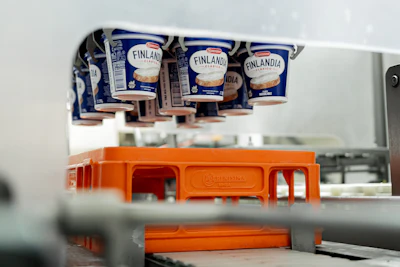
 The new 100% FSC-certified paperboard sleeve and the redesigned cup strike a balance between functionality, aesthetics, and environmental responsibility.Mastellone
 The new 100% FSC-certified paperboard sleeve and the redesigned cup strike a balance between functionality, aesthetics, and environmental responsibility.Mastellone
 The package’s die-cut design balanced strength and practicality: it had to withstand the logistics chain while also allowing the sleeve to be easily removed for recycling.Mastellone
 The paperboard-based cup combines visual sophistication, production efficiency, and environmental responsibility, aligning Finlandia cheese with its premium positioning.Mastellone