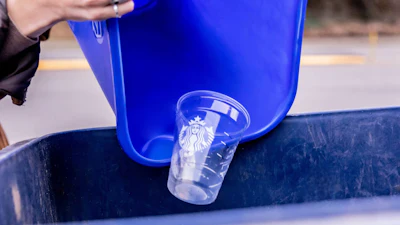
Polypropylene to-go cups have earned the “Widely Recyclable” designation from How2Recycle, North America’s on-pack disposal label. The designation means more than 60% of U.S. households can now recycle these cups through curbside or drop-off programs, expanding access for one of the most widely used forms of foodservice packaging.
The designation is the result of a collaboration among Starbucks, How2Recycle, the NextGen Consortium managed by Closed Loop Partners’ Center for the Circular Economy, The Recycling Partnership, and WM. Together, the partners have worked to improve infrastructure, consumer education, labeling standards, and end markets to make large-scale recycling of PP cups possible.
In the last four months alone, new programs have added recycling access for more than 2 million households. Overall access has grown more than 10% over the last several years, reflecting what the coalition describes as an unprecedented level of collaboration across the industry.
“Achieving the Widely Recyclable designation for polypropylene cups is a significant milestone,” says Marika McCauley Sine, chief sustainability officer at Starbucks. “It reflects what’s possible when businesses, recyclers, and communities work together to create solutions that can reduce waste and make recycling easier for customers who opt for to-go beverages. We’re committed to continuing our collective effort to build a circular system that can benefit people and the planet.”
According to Paul Nowak, executive director of GreenBlue, the non-profit behind How2Recycle, the designation reflects a system-level change rather than a single technical fix. “Expanding access, improving infrastructure, and strengthening consumer communications takes collaboration across the value chain,” he explains. “No single organization can do this alone. The work we’re doing today has benefits beyond any single material. By investing in infrastructure and consumer-tested communications, we’re driving industry and behavior change at scale.”
For its part, the NextGen Consortium, managed by Closed Loop Partners’ Center for the Circular Economy, brought together major businesses including Starbucks to advance solutions that improve the circularity of foodservice packaging. Says Kate Daly, CEO of Closed Loop Partners’ Center for the Circular Economy, “This recycling designation change for polypropylene cups marks an important step forward for the circularity of foodservice packaging in the U.S. … Contributing to this work to make polypropylene cups widely recyclable is part of our broader work to accelerate the recovery, reuse, and recycling of foodservice packaging. We look forward to continuing to expand recycling access for more packaging and materials, a critical part of building a circular economy.”
The Recycling Partnership supported the effort through its Polypropylene Recycling Coalition, which invests in infrastructure, provides education guidance, and supplies real-time data on recycling performance. Kate Davenport, chief impact officer TRP, says, “This is meaningful progress for polypropylene recycling. With 75.5 million households now able to recycle PP cups, we’ve reached the threshold for on-pack labeling, a critical tool for building consumer understanding.
She adds that while it’s a first step worth commending, access alone is not enough. “Only 20% of PP packaging is currently captured, and 76% of all recyclables are still lost at the household level,” she explains. “That’s why our focus remains on what it takes to move the system forward, clear communication, stronger engagement, and continued investment in communities.”
WM contributed to the project by expanding processing capacity and developing end markets with KW Plastics. Accoriding to Tara Hemmer, chief sustainability officer at WM, plastic to-go cups becoming recyclable curbside is a major milestone made possible by years of investment, innovation, and collaboration. “As the largest recycler in North America, we’re proud to help capture and recycle more of the everyday materials people rely on, and this achievement proves what’s possible when communities, companies, and industry leaders come together to make recycling more accessible.”
KW Plastics played a key role in creating demand for recovered material. Stephanie Baker, director of advocacy and marketing at KW Plastics, says “We provide a dependable domestic home for postconsumer polypropylene. We recycle this material every day in the United States, and we see consistent demand from manufacturers who rely on high-quality recycled resin to make new products. Polypropylene has real value. It supports American manufacturing and plays a vital role in building a stronger, more resilient circular economy.
“We have watched demand for postconsumer polypropylene grow steadily over the last decade as more companies shifted toward lighter and more efficient packaging. That change increased the amount of polypropylene on store shelves and in recycling streams. It also created the need for strong domestic markets to keep this material from being exported at low value.”
Industry data show households generate roughly as much PP as high-density polyethylene, yet PP’s recycling rate remains about one third that of HDPE. Coalition members say closing that gap requires continued investment in infrastructure, education, and end markets.
The partners say the Widely Recyclable designation marks a major step forward, but not the end of the work. Ongoing engagement with communities and recyclers remains essential to ensure that more cups are not only accepted in recycling programs, but also successfully recovered and reused. PW