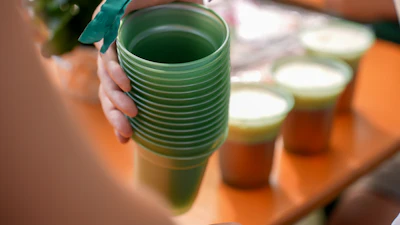
The cups used at Smukfest 2025 were made with 86% rPET and designed for continuous recyclability.
Faerch
A recyclable cup program at Smukfest, one of Denmark’s largest music festivals, is getting closer to perfect circularity.
Smukfest 2025 saw a record 97% return rate for its recyclable cup program, surpassing the previous year’s 95% return rate, according to packaging supplier Faerch.
“Reaching a 97% return rate is largely the result of a joint effort from our volunteers, bar staff, logistics teams, and waste sorting partners – and, of course, the strong support from our guests,” says Cathrine Bianca Christensen, sustainability coordinator at Smukfest. “It shows how small behavioral changes can make a big difference.”
Choosing the circular option
Smukfest introduced its recyclable cup program in 2024, using cups developed in a collaborative effort from Faerch, Royal Unibrew, and Dansk Retursystem.
The cups are made with 86% rPET and 14% virgin plastic and designed for continuous recycling.
Smukfest conducted a lifecycle assessment and environmental assessments to decide between washable, single-use, and circular cups, a report from the festival explains. It considered factors like the logistics of hosting a festival in a forest, space for cup storage and cleaning at the approximately 60 bars on site, and access to the bars during peak times. With these factors in mind, it chose the circular option.
“Circularity and collaboration with our partners are no longer things we just talk about – they are things we do. Smukfest shows that closed loops can work at scale and significantly reduce the need for virgin materials,” Jesper Emil Jensen, regional CEO at Faerch, says in the Faerch release.
Cup collection and handling was handled by Dansk Retursystem, with recycling carried out at Faerch’s Cirrec facility, turning the used cups into new cups or other food packaging.
Strategies to increase recycling participation
To ensure that the cups are circular in practice during the festival, Smukfest implemented a host of incentives and guiding features for attendees and staff.
Included in these incentives were a green fee for all cups, along with a swap-for-new scheme at all bars. A new cup would cost 5 Danish Krone (kr.), or about 16 cents USD, and a used cup could be exchanged for a new one for free.
Return stations were set up to accept used cups, pitchers, cans, and other refundable items. Professional collectors at the festival had their own incentive to support cup returns, with their deposit rate raised from the previous 25 øre to the 2025 rate of 1 kr. Per cup.
Smukfest used an updated sorting bin design developed by its in-house designer, which includes graphics to note the various packaging it can accept.FaerchAlso new for 2025, Smukfest increased the quantity and updated the design of its sorting bins. The festival worked with garbage collection service Johs. Sørensen to develop 500 new waste bins and lids, with the design created by Smukfest’s in-house graphic designer.
The bin design highlights the various packaging they can accept, including bottles, cans, and shot tubes in addition to the recyclable cups.
“Smukfest has its own resource centre where dedicated volunteers sort the contents of the bins. This way, we ensure that clean fractions of cups, cans, bottles, and shot tubes are sent to the appropriate processing facilities for recycling,” the Smukfest report says.
The festival placed a heavy focus on communication to further support program participation, including animation films shown on big screens between concerts, signs and stickers at bars and return stations, aprons for helpers at return stations, QR codes placed on all elements leading to further information about the program, and more.
In total for the event, Smukfest used 926,400 cups, weighing about 9.97 tons. Of the 97% of total cups collected after use, 73.4% (679,914 units) were collected at return stations, 14.4% (133,204 units) were collected at bars, and 9.2% (85,670 units) were returned in sorting bins.
Plans to grow the recyclable cup program
Following up after Smukfest 2025, Royal Unibrew and Faerch now plan to expand their circular cup system for other festivals and events both in Denmark and internationally.
The shared goal between the companies is to make circularity the standard, and in turn reduce the use of virgin plastics in the events industry, the Faerch release says.
“We hope more events and festivals will be inspired to take similar steps,” says Casper Frimann, business development & CSR manager at Royal Unibrew.