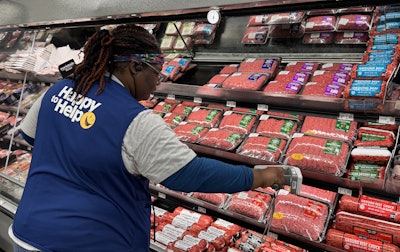
Walmart is expanding the use of RFID technology into one of retail’s most operationally complex areas, fresh food. In October 2025, the retailer announced a collaboration with Avery Dennison to deploy RFID-enabled labels in meat, bakery, and deli departments to improve inventory visibility and reduce food waste.
The system introduces item-level digital identification in categories where short shelf life and frequent stock rotation have traditionally required manual checks. Each product carries an RFID tag embedded in the label, allowing store associates to capture inventory information with handheld scanners. Instead of scanning items one by one, associates can scan an entire shelf or display section and instantly identify products and their use-by dates.
The approach provides faster visibility into what products are on hand and which items require attention, while reducing the amount of time spent on routine inventory tasks.
“We believe technology should make things easier for both our associates and our customers,” says Christyn Keef, VP of front end transformation for Walmart U.S. “By cutting down on manual work, we’re giving our associates more time to focus on what really matters—helping our customers.”
Enabling RFID in refrigerated environments
RFID has been widely adopted in categories such as apparel, but applying the technology to fresh food has proven more complex. Refrigerated cases combine cold temperatures, moisture, and dense products that can interfere with signals and label performance.
Julie Vargas, VP and GM of enterprise intelligent labels growth at Avery Dennison, says these conditions historically limited reliable RFID use in fresh departments. “Ensuring RFID labels are readable and remain fixed to packaging was a longstanding industry challenge in more harsh, fresh environments, particularly within meat categories,” she explains. “The high moisture content, density, and cold temperatures often led to difficulty picking up RFID signals consistently or the labels becoming detached altogether.”
Avery Dennison addressed those issues with a redesigned RFID inlay and label construction engineered for refrigerated environments. Vargas says the company combined materials science expertise with extensive testing to develop the solution. “Avery Dennison’s combination of materials science and deep technology expertise was critical to unlocking this innovation,” she says, noting that the process involved extensive data collection on packaging, products, merchandising, and RFID performance to model real store conditions.
The final design proved capable of delivering consistent read rates in cold and high-moisture environments. Says Vargas, the new inlay design and more durable labeling solution have been able to deliver consistently high read rates, while withstanding harsh conditions.
The RFID tags are integrated into label rollstock that is used by Walmart in store-level labeling processes. That design choice ensures the technology fits into existing workflows rather than introducing additional operational steps. According to Vargas, “This first-to-market solution was designed to fit within existing retailer standard operating procedures, avoiding any disruption or additional labor burden.”
Greater visibility helps reduce labor, food waste
Fresh food departments require constant monitoring to ensure items remain within their shelf life. Traditional inventory checks rely on manual counting and visual inspection of dates, tasks that can take significant time in high-volume categories such as meat.
RFID scanning changes that process. Instead of checking packages one at a time, associates can scan an entire section and quickly review item-level inventory. The system identifies products approaching their expiration dates and highlights items that should be rotated or marked down. The added visibility helps reduce unsold product while keeping shelves stocked with fresh items.
 A report developed by Avery Dennison in collaboration with the Centre for Economics and Business Research estimates that tackling food waste across the global food supply chain could unlock $540 billion by 2026.Avery Dennison
Improving this level of visibility is increasingly important as retailers work to address food waste across the supply chain. A report developed by Avery Dennison in collaboration with the Centre for Economics and Business Research estimates food waste will cost the global retail supply chain $540 billion in 2026. Meat accounts for nearly one-fifth of that total, at $94 billion. The report also found that 74% of businesses surveyed say inflation has complicated meat demand forecasting, while 67% expect meat waste costs to reach a record high this year.
For Walmart, the RFID initiative supports broader sustainability goals tied to waste reduction. The company has set a target to cut global operational food loss and waste intensity in half by 2030. As of 2024, Walmart reported that it had reduced its operational food loss by 21% versus a 2016 baseline. PW