When a leading U.S. producer of pork products expanded its portfolio to include new bacon bit and sliced belly offerings, the company faced an immediate production challenge. The new SKUs required precise, high-speed slicing of pork bellies, but the existing facility had limited available floor space for additional equipment.
Plant leadership also needed to control capital and operating costs while ensuring that food safety, sanitation, and throughput targets were met. Adding multiple standalone machines from different vendors risked increasing both the physical footprint and the project complexity.
The operations team set out to identify a compact, integrated pork belly processing solution that could support the new product line without disrupting existing production flow.
Integrated solution: one line instead of two
The processor initially approached Grote Company to source a high-speed slicer for the application. However, the project required more than just slicing—upstream product handling, controlled transfer, and detection were also necessary to build a complete, production-ready line.
During the evaluation process, the processor learned that PFI, another member of the Grote Company Family of Brands, could supply the additional sanitary conveying and dumping equipment required for the line. By keeping both the slicing and material-handling components within the same brand family, the company was able to simplify the project scope and engage with a single, coordinated supplier.
The resulting collaboration between Grote Company and PFI delivered an integrated pork belly processing line that allowed the plant to operate one consolidated line instead of two, producing a meaningful reduction in both footprint and total installed cost.
After reviewing throughput requirements, product characteristics, and plant layout, the joint solution included:
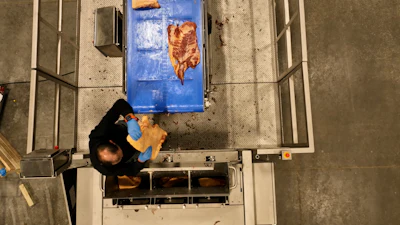
A PFI sanitary, stainless steel two-stage dumper to transfer pork bellies into the line. Immediately downstream, a metal detection system verifies product safety before slicing.
An inclined belt conveyor that moves product from the dumper to a custom PFI platform. The conveyor features tool-free adjustments, simplifying setup and changeover during production.
A Grote High-Speed Slicer configured to produce both bacon bits and sliced pork belly from the same platform, meeting multiple product specifications without additional lines.
To further streamline execution, the processor selected PFI as the single point of contact for the project. This centralized project management structure simplified communication, scheduling, and coordination between equipment disciplines.
Through joint engineering, factory testing, and coordinated installation support, PFI and Grote Company delivered the complete line on time and fully commissioned to meet the processor’s production ramp schedule.
From an operations standpoint, the most significant gain came from reclaiming valuable floor space. By consolidating what would have been a two-line configuration into a single integrated system, the plant reduced congestion, simplified traffic flow, and lowered overall equipment and utility costs.
Slices of pork belly pass through a metal detector.PFI
The integrated approach also delivered:
Improved material flow from raw pork bellies to finished sliced and diced product
Reduced labor complexity through simplified line supervision
Strong sanitation performance through open, accessible, stainless-steel design
Faster startup and changeovers enabled by tool-free conveyor adjustments
For the plant’s operations and engineering teams, the project demonstrated the value of sourcing interconnected equipment through a coordinated supplier strategy rather than managing multiple independent vendors.
Looking ahead: a platform for future line expansions
With the pork belly slicing line fully operational, the processor now has a proven reference for future capacity expansions and new product introductions. The successful execution has already laid the groundwork for additional projects with the Grote Company Family of Brands, allowing the manufacturer to leverage a shared engineering philosophy, unified project management, and long-term service support.
The ability to collaborate across multiple equipment brands within a single organization provides the processor with faster project timelines, reduced integration risk, and a simplified procurement process—advantages that are increasingly important as plants continue to optimize space, labor, and capital investment.