Stampede Culinary Partners takes a bare structure in New Mexico and turns it into an advanced facility with the flexibility to handle a variety of needs for its clients.
Stampede’s Sunland Park site was the company's first to implement post-lethality slicing and smoke capabilities.
Stampede Culinary Partners
Stampede Culinary Partners acquired its Sunland Park, N.M., plant in 2018, and to say it was ready to run from the outset would be a massive exaggeration. As John Villa, Vice President of Operations, describes the 100,000-sq-ft site previously owned by Tyson, it was “essentially a startup.” With only a bare structure, Stampede would soon transform the facility into what would become one of the company’s most advanced and flexible prepared-protein plants.
The project team had to redo most everything on the facility—even the copper wire had been taken.Stampede Culinary Partners“When we bought it, we basically had the walls in the plant and that was it,” Villa says. “We redid the floors, ceilings, all the lights, plumbing, and electrical. Even the copper wire had been taken, so it was a complete rebuild.” That rebuild included a new roof—an investment of more than a million dollars—and full modernization of the plant’s infrastructure.
The renovation moved quickly. “Brock’s directive was to be running in 2018,” Villa says, referring to Stampede CEO Brock Furlong. “We bought it in 2018 and were running on the grind line by December. Some of the bigger installations, like the ovens, came online by January 2019.” From the lights to the ovens, most of the equipment on the floor is 2018 or newer, underscoring the plant’s modern build and reliability.
Layout and process design
The Sunland Park facility was engineered for both food safety and operational efficiency. The team began by dividing the plant into separate raw and cooked zones with the ovens placed in the middle, serving as the dividing line.
Stampede Culinary Partners
Location: Sunland Park, N.M.
Size: 100,000 sq ft (renovation)
Products: Prepared protein
Max Production: 250,000 lbs/wk
Owner: Stampede Culinary Partners
“We knew we wanted two sides of the plant,” Villa explains. “The ovens are pretty much centrally based, so production space is about 50-50—maybe 55-45 toward the raw side. They’re pass-through ovens: one door opens on the raw side, one on the cooked side. It’s never going to change.”
That configuration supports Stampede’s goal of maintaining the highest level of control during post-lethality handling. “We designed it for post-lethality exposed slicing, essentially a clean room,” he says. “We developed not only the equipment flow but also our food safety programs around that design. No exceptions.”
Equipment and engineering
The rebuild equipped Sunland Park with a modern suite of processing technology: multi-vacs, tumblers, injectors, mixers, slicers, and smokehouses configured for flexibility and throughput. Although most of the equipment is newer, a few pieces, such as an older injector, were relocated from the company’s Chicagoland plant to New Mexico.
Ten large ovens were installed simultaneously, creating a complex logistical effort that required long lead times and precise planning. “We had a very aggressive timeline,” Villa says. “Lead time on the ovens was about eight months at the time. That stretched because we were getting ten at once, but we still started production in January 2019.”
The plant was designed with scalability in mind—something Villa calls an intentional risk. “You’ve got to take on some risk and be ready when the business comes,” he says. “That’s where the ‘if you build it, they will come’ mindset comes from. We’ve set up lines that are ready to go so we can trigger production when customers are ready.”
Clean room operations
The facility’s clean room is one of its defining features because it enables ready-to-eat slicing while maintaining high sanitation control. The setup demanded not only infrastructure investment but also process discipline.
“It’s difficult to have a clean room in an industry like this, where everything gets washed down every day,” Villa explains. “You have to be on top of sanitation, on top of testing, and very aware of what’s being touched, how drains are managed, and how airflow works.”
The Sunland Park site was Stampede’s first to implement post-lethality slicing and smoke capabilities, representing a significant step forward in product diversification. “In 2018, we didn’t have any smoke or post-lethality slicing capability,” Villa says. “That was all new here as of January 2019.”
Flexibility and batch design
Stampede's focus on people provides the company with the flexibility to meet customer product needs.Stampede Culinary PartnersWhile many modern facilities lean heavily on automation, Stampede’s Sunland Park plant is intentionally focused on people. “The biggest thing we’re looking for is flexibility,” Villa says, explaining one of the reasons why the facility didn’t incorporate as much automation. “We do an analysis of where the bottlenecks are. If the cook process—like a 14-hour sous vide run—is the bottleneck, then the hand trimming isn’t slowing us down.”
That flexibility allows Stampede to serve both large national accounts and smaller customers requiring specialized runs. “We run 50,000 pounds a day on some slicers,” Villa says, “but we also take on smaller opportunities. We can perfect the product for what the customer needs without saying it’s not big enough for us.”
The approach extends to equipment choice. “We’re batch-oriented, so we’ll go smaller,” Villa explains. “Our tumblers are around 1,000 pounds. We’re not doing 3,000- or 4,000-pound batches because we change over to different products throughout the day. Smaller batch equipment gives us the flexibility to handle multiple SKUs.”
Product innovation
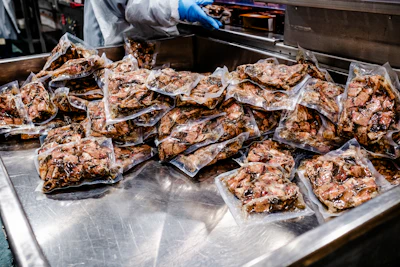
The facility’s combination of smoke, par-fry, and sous vide processing has been central to Stampede’s growth. “The sous vide, the combination of the par fry with the smoke and the sous vide—it’s something brand new for the company,” Villa says. “When we first ran smoked sliced brisket, we were doing maybe 5,000 pounds a week. Now it’s over 150,000 pounds a week on a regular basis, and it can go up to 250,000.”
The success of the company’s endeavors can be seen in the quality and consistency of the finished product. “You get that rich smoky flavor while retaining moisture,” he says. “We’re not over-drying through the smoke process because we combine it with sous vide. It eats very well and has taken off in both retail and foodservice.”
That quality translates to value for operators facing labor shortages. “We do all the heavy lifting,” Villa says. “All the back-of-the-kitchen work is done here. We can go down to 2-oz portions, ready for burritos or bowls. There’s no guesswork, and it helps our customers save on labor and food costs.”
Food safety and pasteurization
Food safety innovation at Sunland Park includes the development of Stampede’s proprietary Low Temperature Pasteurization (LTP) process, designed as an alternative to high-pressure processing.
Stampede's proprietary LTP process is an alternative to HPP that still offers an extended shelf life.Stampede Culinary Partners“In the clean room, the product gets exposed again, so we wanted another kill step,” Villa explains. “That’s where LTP came in. It’s our belt-and-suspenders approach to food safety.” The process not only provides additional pathogen control but also extends refrigerated shelf life—often tripling it.
“Customers want to move toward fresh products, but that can be rough on operations,” Villa says. “With LTP, we get longer shelf life and confidence in safety, which gives both us and our customers flexibility. It also reduces food waste because the product can stay in rotation longer.”
Unlike HPP, LTP is gentle on the product. “HPP can cause compression and dry the product out,” Villa says. “With LTP, the product comes out the same way it went in, but with extended shelf life and the same quality.” The process, developed in Sunland Park by Stampede’s R&D team, avoids the cost of installing or tolling for HPP systems—another operational advantage.
Workforce and training
Beyond equipment and process innovation, Villa is equally proud of what the plant represents for the local community. “We’re the largest employer in southern New Mexico in this area,” he says. “It gives people a chance to advance their careers and learn new skills.”
Stampede has partnered with New Mexico State University (NMSU) and Dona Ana Community College to provide training programs in ammonia refrigeration, forklift operation, and butchery. “We built a butcher certification program with NMSU that all of our trimmers—not only here, but at our other facilities in Georgia, Illinois, and Canada—went through,” Villa says. “We created it here, and now hundreds of people across the company have benefited.”
Lessons learned and future outlook
Villa describes the Sunland Park project as a study in risk management, flexibility, and disciplined execution. “You’ve got to have patience, and you’ve got to be willing to take some risk,” he says. “When we started, we had two smokehouses. Now we have seven. You wonder if you’ll have that business consistently, but if you stay disciplined on quality and keep those ovens full, it pays off.”
That forward-looking mentality extends to product and process development. “When we first started in the clean room, we had nothing—just one multi-vac and a slicer,” Villa recalls. “Now we have four multi-vacs, ten slicers, and two tumblers. It expanded because we kept seeing where the market was going and stayed ahead of it.”
Stampede’s approach, he says, is fundamentally customer-driven. “We don’t have a product list or a price list,” Villa explains. “We come in and ask, ‘What are you trying to achieve?’ Our R&D team helps formulate something specific to those needs. Once it’s here, we keep it consistent. We might do a dozen versions of smoked sliced brisket—each one unique to a customer—but every SKU is made to the same high standard.”
Ultimately, Villa says, the Sunland Park facility embodies the company’s balance between flexibility and precision. “We take on both big and small opportunities,” he says. “Because we know the small ones can grow into something like 150,000 pounds a week. Having that flexibility—and the systems in place to support it—is what makes this plant work.”
 The project team had to redo most everything on the facility—even the copper wire had been taken.Stampede Culinary Partners